Posts

Book: Brain Changer

Brain Changer eBook

Book Title:

Brain Changer: How diet can save your mental health – cutting-edge science from an expert.

Author(s): Felice Jacka.

Year: 2019.

Edition: First (1st).

Publisher: Yellow Kite.

Type(s): Paperback, Audiobook, and Kindle.

Synopsis:

A combination of Professor Felice Jacka’s love of food and her own experience of depression and anxiety as a young woman led her to question whether what we put in our mouths everyday affects more than our waistline. Felice set out on a journey of discovery to change the status quo and uncover the truth through rigorous science. Beginning her PhD in 2005, she examined the association between women’s diets and their mental health, focusing on depression and anxiety. She soon discovered – you feel how you eat. It is Professor Jacka’s ground-breaking research that has now changed the way we think about mental and brain health in relation to diet.

Brain Changer explains how and why we should consider our food as the basis of our mental and brain health throughout our lives. It includes a selection of recipes and meal plans featuring ingredients beneficial to mental health. It also includes the simple, practical solutions we can use to help prevent mental health problems in the first place and offers strategies for treating these problems if they do arise.

This is not a diet book to help you on the weight scales. This is a guide to good habits to save your brain and to optimise your mental health through what you eat at every stage of life.

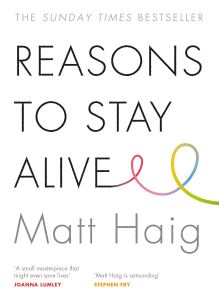
Book: Reasons to Stay Alive

Book Title:

Reasons to Stay Alive.

Author(s): Matt Haig.

Year: 2015.

Edition: First (1st).

Publisher: Canongate Books Ltd.

Type(s): Hardcover, Paperback, Audiobook, and Kindle.

Synopsis:

Aged 24, Matt Haig’s world caved in. He could see no way to go on living. This is the true story of how he came through crisis, triumphed over an illness that almost destroyed him and learned to live again.

A moving, funny and joyous exploration of how to live better, love better and feel more alive, Reasons to Stay Alive is more than a memoir. It is a book about making the most of your time on earth.

“I wrote this book because the oldest clichés remain the truest. Time heals. The bottom of the valley never provides the clearest view. The tunnel does have light at the end of it, even if we haven’t been able to see it . . . Words, just sometimes, really can set you free.”

Book: Suicide Prevention Handbook

Book Title:

Suicide Prevention Handbook: A Mental Health Guide For Saving Lives.

Author(s): Ben Oakley.

Year: 2020.

Edition: First (1st).

Publisher: Independently Published.

Type(s): Paperback and Kindle.

Synopsis:

The book includes our detailed four-step guide for suicide prevention:

  • Warning Signs include social signs, personal signs and planning signs.
  • Risk Factors include isolation and social inequality, violence or abuse, self-harm and mental health disorders.
  • Intervention includes social intervention, personal intervention including exactly what to say to start a mental health conversation and how to seek help.
  • Coping Strategies include distraction, grounding and relaxation.

With real-world examples and concrete ways of how to help yourself or another.

Many mental health advocates and organisations recommend you talk about mental health but they don’t tell you how to get the conversation started. This book provides you with Conversation Starters, Direct Questions, Indirect Questions, Example Lists, Guidance and ways to move a conversation from negative emotions to positive ones.

Along with the extensive four-step suicide prevention handbook, there is a guide to writing your own suicide prevention life plan with tips on creating priorities, goals, action plans and how to write it.

You’ll also find a list of UK mental health organisations, what not to say, myths debunked and a series of essays about the misconception of man.

Supreme Movement is a mental health awareness social enterprise in the United Kingdom whose mission is to raise awareness of mental health issues, specifically suicide and self-harm among males.

Ben Oakley is an established non-fiction author, researcher, mental health advocate and founder of Supreme Movement.

Mental Disorders, Personality Traits & Impaired Work Functioning: Is There an Association?

Research Paper Title

Mental disorders and personality traits as determinants of impaired work functioning.

Background

Both mental disorders and personality characteristics are associated with impaired work functioning, but these determinants have not yet been studied together. The aim of this paper is to examine the impairing effects that mental disorders and personality characteristics (i.e. neuroticism, locus of control and self-esteem) have on work functioning.

Methods

Data for a representative sample of 3570 working people were derived from the first two waves of the Netherlands Mental Health Survey and Incidence Study (NEMESIS), a prospective cohort study in the Dutch adult population.

Results

Higher neuroticism, more external locus of control and lower self-esteem were each significantly associated with subsequent impairment in work functioning, independently of any effects from mental disorders. Associations between mental disorders and subsequent work impairment disappeared once personality traits were taken into account. Personality traits did not moderate the relationships between mental disorders and work functioning.

Conclusions

Working people with vulnerable personalities have a greater risk of impaired work functioning, independent of the risk from any mental disorder they may have.

Reference

Michon, H.W.C., Have, M.T., Kroon, H., van Weeghel, J., de Graaf, R. & Schene, A.H. (2020) Mental disorders and personality traits as determinants of impaired work functioning. Psychological Medicine. 38(11), pp.1627-1637. doi: 10.1017/S0033291707002449. Epub 2008 Jan 21.

On This Day … 29 November

People (Births)

  • 1825 – Jean-Martin Charcot, French neurologist and psychologist (d. 1893).
  • 1945 – Csaba Pléh, Hungarian psychologist and linguist.

Jean-Martin Charcot

Jean-Martin Charcot (29 November 1825 to 16 August 1893) was a French neurologist and professor of anatomical pathology.

He is best known today for his work on hypnosis and hysteria, in particular his work with his hysteria patient Louise Augustine Gleizes.

Charcot is known as “the founder of modern neurology”, and his name has been associated with at least 15 medical eponyms, including Charcot-Marie-Tooth disease and Charcot disease.

Charcot has been referred to as “the father of French neurology and one of the world’s pioneers of neurology” His work greatly influenced the developing fields of neurology and psychology; modern psychiatry owes much to the work of Charcot and his direct followers.

He was the “foremost neurologist of late nineteenth-century France” and has been called “the Napoleon of the neuroses”.

Csaba Pleh

Csaba Pléh (born 29 November 1945) is a Hungarian psychologist and linguist, professor at the Department of Cognitive Science, Budapest University of Technology and Economics.

He graduated from the Eötvös Loránd University where he earned his degrees in psychology (1969) and linguistics (1973). In 1970 he received his PhD in psychology. He became Candidate of Psychological Science in 1984 and Doctor of Psychological Science in 1997. He obtained his habilitation in 1998. He became a corresponding member of the Hungarian Academy of Sciences is 1998, a full member in 2004.

Psychiatrists have Started the Process of Mapping Genetic Architecture of Mental Disorders

Research Paper Title

Psychiatrists begin to map genetic architecture of mental disorders.

Background

Mental illness affects one in six US adults, but scientists’ sense of the underlying biology of most psychiatric disorders remains nebulous.

That is frustrating for physicians treating the diseases, who must make diagnoses based on symptoms that may only appear sporadically.

Now, a large-scale analysis of postmortem brains is revealing distinctive molecular traces in people with mental illness.

An international team of researchers reports that five major psychiatric disorders have often overlapping patterns of gene activity, which furthermore vary in disease-specific – and sometimes counterintuitive – ways.

The findings, they say, might someday lead to diagnostic tests, and one has already inspired a clinical trial of a new way to treat overactive brain cells in autism.

Reference

Dengler, R. (2020) Psychiatrists begin to map genetic architecture of mental disorders. Neuroscience. 359(6376), pp.619. DOI: 10.1126/science.359.6376.619

Book: Developing Resilience: A Cognitive-Behavioural Approach

Book Title:

Developing Resilience: A Cognitive-Behavioural Approach.

Author(s): Michael Neenan.

Year: 2017.

Edition: Second (2nd).

Publisher: Routledge.

Type(s): Hardcover and Kindle.

Synopsis:

Some individuals emerge from grim experiences stronger in mind and spirit than others who suffered the same ordeal. In this updated and revised edition, Michael Neenan focuses on the meanings we attach to life’s adversities in order to understand how we respond to them. This is why different people can react to the same adverse event in a variety of ways such as fighting back or crumbling. Different meanings of what constitutes resilience are also discussed and the author takes issue with the simplistic view of it as bouncing back from adversity which suggests the absence of struggle and emotional pain as well as underestimating how long the process of self-righting can sometimes take.

Developing Resilience shows how people can find constructive ways of dealing with hard times by using the ideas and techniques of cognitive behavioural therapy as well as drawing on the viewpoints and experiences of other writers presented here. This book provides useful guidance and advice on topics including:

  • Managing negative emotions in difficult times.
  • Using an assets and liabilities model to understand resilient behaviour.
  • Distinguishing between what’s within and outside of your control.
  • Identifying and changing attitudes that undermine resilience building.
  • Developing self-belief.
  • Increasing your level of frustration tolerance.
  • Maintaining a resilient outlook.

This book will be essential reading for anyone interested in learning more about resilience as well as for mental health professionals, coaches and therapists looking for guidance in helping their clients to cope better with adversity.

Book: Mental and behavioural state examination: Theory into Practice – A Nurse’s Perspective on Psychiatric Assessment

Book Title:

Mental and behavioural state examination: Theory into Practice – A Nurse’s Perspective on Psychiatric Assessment.

Author(s): Tim Whittard.

Year: 2020.

Edition: First (1st), Illustrated Edition.

Publisher: The Choir Press.

Type(s): Paperback.

Synopsis:

The ability to carry out assessments of mental and behavioural state is a useful and required skill for those who work within the healthcare industry, as well as in other professions where there is a routine requirement to work with vulnerable members of the public; this includes nurses and therapists of all specialties and backgrounds, midwives, care assistants, doctors, social workers, school teachers and emergency services, including paramedics and police officers (among numerous other professional groups).

This book attempts to break down each aspect of the assessment using psychiatric terminology, definitions and examples in order to provide the reader with a comprehensive guide in how to carry out mental and behavioural state examinations (MBSEs) which is both detailed and concise.

It is an essential handbook for those novices and more experienced clinicians alike, who wish to have a concise directory of some of the basic and core theoretical principles which underpin the process of non-medical psychiatric assessment in the 21st century.

Book: The Empire of Depression: A New History

Book Title:

The Empire of Depression: A New History.

Author(s): Jonathan Sadowsky.

Year: 2020.

Edition: First (1st).

Publisher: Polity.

Type(s): Hardcover and Kindle.

Synopsis:

Depression has colonised the world. Today, more than 300 million of us have been diagnosed as depressed. But 150 years ago, “depression” referred to a mood, not a sickness.

Does that mean people were not sick before, only sad? Of course not. Mental illness is a complex thing, part biological, part social, its definition dependent on time and place. But in the mid-twentieth century, even as European empires were crumbling, new Western clinical models and treatments for mental health spread across the world. In so doing, “depression” began to displace older ideas like “melancholia,” the Japanese “utsushō,” or the Punjabi “sinking heart” syndrome.

Award-winning historian Jonathan Sadowsky tells this global story, chronicling the path-breaking work of psychiatrists and pharmacists, and the intimate sufferings of patients. Revealing the continuity of human distress across time and place, he shows us how different cultures have experienced intense mental anguish, and how they have tried to alleviate it.

He reaches an unflinching conclusion: the devastating effects of depression are real. A number of treatments do reduce suffering, but a permanent cure remains elusive. Throughout the history of depression, there have been overzealous promoters of particular approaches, but history shows us that there is no single way to get better that works for everyone. Like successful psychotherapy, history can liberate us from the negative patterns of the past.

Book: Lucy’s Blue Day

Book Title:

Lucy’s Blue Day: Children’s Mental Health Book.

Author(s): Christopher Duke (Author) and Federica Bartolini (Illustrator).

Year: 2019.

Edition: First (1st).

Publisher: Independently Published.

Type(s): Paperback.

Synopsis:

Lucy is a very special little girl with magical hair.

It changes colour with her emotions. If she is feeling happy, it is purple. If she is jealous, it will turn green.

This charming story is the tale of when Lucy wakes up and her hair is blue, and she does not understand why.

She soon learns that it is #OKNotToBeOK