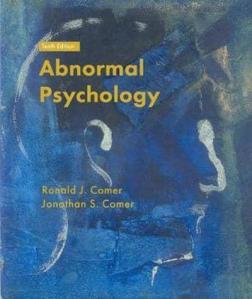
Book: Abnormal Psychology

300300

Book Title:

Abnormal Pyschology.

Author(s): Ronald J. Comer and Jonathan S. Comer.

Year: 2018.

Edition: Tenth (10th).

Publisher: Worth Publihsers.

Type(s): Hardback.

Synopsis:

Taking a look at the field of abnormal psychology, including major theoretical models of abnormality, research directions, clinical experiences, therapies and controversies, this book covers personality disorders, the psychodynamic perspective, neuroscience, the ’empirically-based treatment’ movement, and more.

Book: Psychodynamic Therapy for Personality Pathology

Book Title:

Psychodynamic Therapy for Personality Pathology: Treating Self and Interpersonal Functioning

Author(s): Eve Valigor PhD, Ott, F, Kernberg M.D., John F. Clarkin PhD, and Frank E Yeomans M.D. PhD.

Year: 2018.

Edition: First (1ed).

Publisher: American Psychiatric Association Publishing.

Type(s): Paperback.

Synopsis:

Deftly integrating contemporary psychiatry and contemporary psychoanalysis, Psychodynamic Therapy for Personality Pathology: Treating Self and Interpersonal Functioning introduces Dynamic Psychotherapy for Personality Disorders (DPD), a specialised, theory-driven approach to the treatment of personality disorders.

Beyond merely being compatible with the DSM-5 Section III Alternative Model for Personality Disorders, this guide elaborates on it, offering clinicians at all levels of experience an accessible framework to guide evaluation and treatment of personality disorders in a broad variety of clinical and research settings.In this volume, readers will find:

  • A coherent model of personality functioning and disorders based in psychodynamic object relations theory.
  • A clinically near approach to the classification of personality disorders, coupled with a comprehensive approach to assessment.
  • An integrated treatment model based on general clinical principles that apply across the spectrum of personality disorders.
  • An understanding of specific modifications of technique that tailor intervention to the individual patient’s personality pathology.
  • Descriptions of specific psychodynamic techniques that can be exported to shorter-term treatments and acute clinical settings.

Patient assessment and basic psychodynamic techniques are described in up-to-date, jargon-free terms and richly supported by numerous clinical vignettes, as well as online videos demonstrating interventions. At the end of each chapter, readers will find a summary of key clinical concepts, making this book both a quick reference tool as well as a springboard for continued learning. Clinicians looking for a novel guide to understanding and treating personality pathology that combines contemporary theory with clinical practice need look no further than Psychodynamic Therapy for Personality Pathology: Treating Self and Interpersonal Functioning.

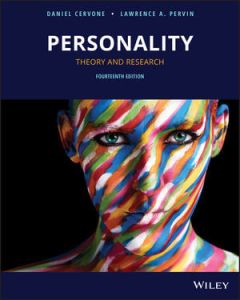
Book: Personality: Theory and Research

Book Title:

Personality: Theory and Research.

Author(s): Daniel Cervone and Lawrence A. Pervin.

Year: 2019.

Edition: Fourteenth (14th).

Publisher: Wiley.

Type(s): Hardcover and ebook (from Wiley).

Synopsis:

An invaluable resource for over four decades, Personality examines the fundamental theories and concepts of personality psychology while exploring contemporary research, new methodologies, and the latest technological advancements.

Through a well-rounded blend of theory, case studies, and the latest research, this text identifies the structures and processes of personality, traces personality development, and highlights the value of therapeutic change.

An effective pedagogical structure enhances student interest while strengthening objectivity and critical-thinking skills.

Psychodynamic, social-cognitive, phenomenological, and trait-theoretic perspectives are presented in an unbiased – yet critical – fashion that encourages students to compare theories, evaluate evidence, analyse data, and form their own conclusions.

Thorough historical coverage is balanced with discussions of the current state of the field, providing a solid understanding of theory and methods as relevant to practice today.

Suitable for introductory coursework, this text also serves as a valuable resource for advanced studies and as a reference for professionals in psychology and related fields.

Identifying Mental Illness

Mental illness cannot always be clearly differentiated from normal behaviour.

For example, distinguishing normal bereavement from depression may be difficult in people who have had a significant loss, such as the death of a spouse or child, because both involve sadness and a depressed mood.

In the same manner, deciding whether a diagnosis of anxiety disorder applies to people who are worried and stressed about work can be challenging because most people experience these feelings at some time.

The line between having certain personality traits and having a personality disorder can be blurry.

Thus, mental illness and mental health are best thought of as being on a continuum.

Any dividing line is usually based on the following:

  • How severe the symptoms are;
  • How long symptoms last; and
  • How much symptoms affect the ability to function in daily life.