On This Day … 08 October

People (Births)

  • 1888 – Ernst Kretschmer, German psychiatrist and author (d. 1964).

Ernst Kretschmer

Ernst Kretschmer (08 October 1888 to 08 February 1964) was a German psychiatrist who researched the human constitution and established a typology.

He attempted to correlate body build and physical constitution with personality characteristics and mental illness.

On This Day … 13 September

Events

  • 1848 – Vermont railroad worker Phineas Gage survives an iron rod 1 1⁄4 inches (3.2 cm) in diameter being driven through his brain; the reported effects on his behaviour and personality stimulate discussion of the nature of the brain and its functions.

People (Deaths)

  • 1999 – Benjamin Bloom, American psychologist and academic (b. 1913).

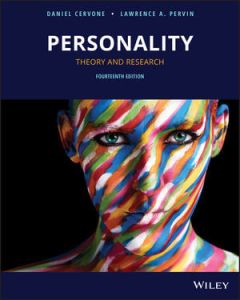
Book: Personality: Theory and Research

Book Title:

Personality: Theory and Research.

Author(s): Daniel Cervone and Lawrence A. Pervin.

Year: 2019.

Edition: Fourteenth (14th).

Publisher: Wiley.

Type(s): Hardcover and ebook (from Wiley).

Synopsis:

An invaluable resource for over four decades, Personality examines the fundamental theories and concepts of personality psychology while exploring contemporary research, new methodologies, and the latest technological advancements.

Through a well-rounded blend of theory, case studies, and the latest research, this text identifies the structures and processes of personality, traces personality development, and highlights the value of therapeutic change.

An effective pedagogical structure enhances student interest while strengthening objectivity and critical-thinking skills.

Psychodynamic, social-cognitive, phenomenological, and trait-theoretic perspectives are presented in an unbiased – yet critical – fashion that encourages students to compare theories, evaluate evidence, analyse data, and form their own conclusions.

Thorough historical coverage is balanced with discussions of the current state of the field, providing a solid understanding of theory and methods as relevant to practice today.

Suitable for introductory coursework, this text also serves as a valuable resource for advanced studies and as a reference for professionals in psychology and related fields.

Book: A Beautiful Mind

Book Title: A Beautiful Mind.

Original Title: A Beautiful Mind: a Biography of John Forbes Nash, Jr., Winner of the Nobel Prize in Economics, 1994.

Author: Sylvia Nasar.

Year: 1998.

Publisher: Simon & Schuster.

Synopsis:

A Beautiful Mind (1998) is a biography of Nobel Prize-winning economist and mathematician John Forbes Nash, Jr. by Sylvia Nasar, professor of journalism at Columbia University.

An unauthorised work, it won the National Book Critics Circle Award in 1998 and was nominated for the Pulitzer Prize in biography.

It inspired the 2001 film by the same name.

Starting with his childhood, the book covers Nash’s years at Princeton and MIT, his work for the RAND Corporation, his family and his struggle with schizophrenia.

Although Nasar notes that Nash did not consider himself a homosexual, she describes his arrest for indecent exposure and firing from RAND amid the suspicion that he was, then considered grounds for revoking one’s security clearance.

The book ends with Nash being awarded the Nobel Prize in Economics in 1994.

The book is a detailed description of many aspects of Nash’s life, including the nature of his mathematical genius, and a close examination of his personality and motivations.

Identifying Mental Illness

Mental illness cannot always be clearly differentiated from normal behaviour.

For example, distinguishing normal bereavement from depression may be difficult in people who have had a significant loss, such as the death of a spouse or child, because both involve sadness and a depressed mood.

In the same manner, deciding whether a diagnosis of anxiety disorder applies to people who are worried and stressed about work can be challenging because most people experience these feelings at some time.

The line between having certain personality traits and having a personality disorder can be blurry.

Thus, mental illness and mental health are best thought of as being on a continuum.

Any dividing line is usually based on the following:

  • How severe the symptoms are;
  • How long symptoms last; and
  • How much symptoms affect the ability to function in daily life.