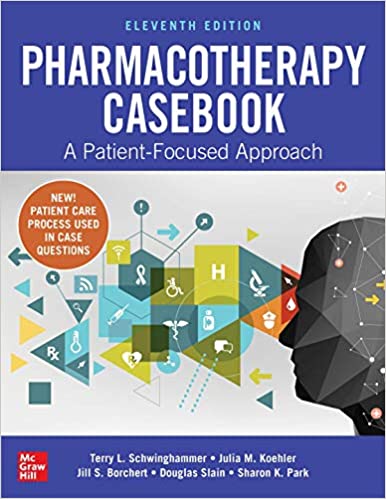
Book: Pharmacotherapy Casebook – A Patient-Focused Approach

Book Title:

Pharmacotherapy Casebook – A Patient-Focused Approach.

Author(s): Terry Schwinghammer. Julia Koehler, Jill Borchert, Douglas Slain, and Sharon Park.

Year: 2020.

Edition: Eleventh (11ed).

Publisher: McGraw-Hill Education.

Type(s): Paperback and Kindle.

Synopsis:

Packed with 157 patient cases, Pharmacotherapy Casebook: A Patient-Focused Approach builds your problem-solving and decision-making skills, so you can identify and resolve the most common drug therapy challenges you will encounter in daily practice.

Its case-based approach is also ideal for PharmD, Nurse Practitioner, and other allied health courses. Providing a consistent, practical approach, this authoritative guide delivers everything you need to master patient communication, care plan development, and documenting interventions. Case chapters are organised into system sections that correspond to those of the companion textbook.

Sharpen your ability to:

  • Identify actual or potential drug therapy problems.
  • Determine the desired therapeutic outcome.
  • Evaluate therapeutic alternatives.
  • Design an optimal individualised pharmacotherapeutic plan.
  • Evaluate the therapeutic outcome
  • Provide patient education.
  • Communicate and implement the therapeutic plan.

Develop expertise in pharmacotherapy decision making with:

  • Realistic patient presentations that include medial history, physical examination, and laboratory data, followed by a series of questions using a systematic, problem-solving approach
  • A broad range of cases – from a single disease state to multiple disease states and drug-related problems
  • Expert coverage that integrates the biomedical and pharmaceutical sciences with therapeutics
  • Appendices containing sample answer to several cases and valuable information on medical abbreviations, laboratory tests, mathematical conversion factors, and anthropometrics


Patients Dependent on Benzodiazepines: Make Alliances

Research Paper Title

Making Alliances With Patients Dependent on Benzodiazepines: A Provider’s Experience.

Abstract

Tens of millions of benzodiazepine (BZD) prescriptions are written annually for the outpatient management of anxiety disorders and insomnia.

Many prescribers do not follow published treatment guidelines for these disorders.

Psychiatric-mental health nurse practitioners (PMHNPs) regularly meet patients who have been treated with BZDs for years.

The dangers posed by outpatient BZD use are recognised, especially among older adults, and their use should be minimised or eliminated.

There are multiple manualised approaches to outpatient down-titration of BZDs, but little evidence about which methods really work.

To effect change, it is essential that PMHNPs establish a sound therapeutic alliance with these patients, especially by using their skills in therapeutic communication.

One major conflict that may occur early in the relationship is the patient’s expectation that the BZD medication regimen will continue indefinitely and their unwillingness to risk discontinuing the drug.

This conflict commonly raises non-adherence to a down-titration plan or patient termination of the relationship.

It is essential that PMHNPs take the time and patience to build strong therapeutic alliances with patients to design and implement a successful BZD discontinuation regimen.

Reference

Amberg, A. (2020) Making Alliances With Patients Dependent on Benzodiazepines: A Provider’s Experience. Journal of Pyschosocial Nursing and Mental Health Services. 58(1), pp.29-32. doi: 10.3928/02793695-20191218-06.

Examining the Role the Inflammatory Process & Immune System Play in Mental Disorder

Research Paper Title

Inflammatory Response and Treatment-Resistant Mental Disorders: Should Immunotherapy Be Added to Pharmacotherapy?

Abstract

Treatment resistance continues to challenge and frustrate mental health clinicians and provoke psychiatric researchers to seek additional explanatory theories for psychopathology.

Because the inflammatory process activates symptoms of depression, anxiety, and psychosis, it is a reasonable route to follow for primary and/or indirect contribution to mental disorders.

The current article reviews the research literature regarding the role the inflammatory process and immune system play in mental disorders as well as novel treatments under investigation for resistant depression, anxiety, substance use, and psychotic disorders.

Reference

Limandri, B.J. (2020) Inflammatory Response and Treatment-Resistant Mental Disorders: Should Immunotherapy Be Added to Pharmacotherapy? Journal of Psychosocial Nursing and Mental Health Services. 58(1), pp.11-16. doi: 10.3928/02793695-20191218-03.

Inflammatory Response & Treatment-Resistant Mental Disorders

Research Paper Title

Inflammatory Response and Treatment-Resistant Mental Disorders: Should Immunotherapy Be Added to Pharmacotherapy?

Abstract

Treatment resistance continues to challenge and frustrate mental health clinicians and provoke psychiatric researchers to seek additional explanatory theories for psychopathology.

Because the inflammatory process activates symptoms of depression, anxiety, and psychosis, it is a reasonable route to follow for primary and/or indirect contribution to mental disorders.

The current article reviews the research literature regarding the role the inflammatory process and immune system play in mental disorders as well as novel treatments under investigation for resistant depression, anxiety, substance use, and psychotic disorders.

Reference

Limandri, B.J. (2020) Inflammatory Response and Treatment-Resistant Mental Disorders: Should Immunotherapy Be Added to Pharmacotherapy? Journal of Psychosocial Nursing and Mental Health Services. 58(1), pp.11-16. doi: 10.3928/02793695-20191218-03.

Reduction of Plasma Procoagulant Activity in Patients with Schizophrenia during Pharmacotherapy

Research Paper Title

[Reduction of plasma procoagulant activity in patients with schizophrenia during pharmacotherapy: thrombodynamic parameters of coagulation before and after treatment].

Background

To detect plasma procoagulant activity in patients with schizophrenia at admission to the hospital in a state of exacerbation before (point 1) and after (point 2) pharmacotherapy and evaluate plasma and platelet hemostasis abnormalities.

Methods

The study included 80 women, aged from 16 to 57 years, median age 28 years, with schizophrenia with continuous, paroxysmal-progressive or paroxysmal course (F20.00, F20.01, F20.02 according to ICD-10).

In 42 of 80 patients, depressive disorders in the structure of schizophrenia were observed. The thrombodynamic test (TD) was performed on T-2 Trombodynamis device according to the manufacturer’s instructions (Hemacore LLC, Moscow, Russia).

Blood for the TD test was taken in admission to the hospital (point 1) and on discharge (point 2). All patients received standard pharmacotherapy according to their condition.

Results

For the first time, it was established that in the whole group of patients (n=46) thrombodynamic indicators of the rate of growth of the clot: initial velocity (Vin), stationary velocity (Vst) and adjusted for spontaneous clots velocity (V) and the amount of clot for 30 minutes test TD (ClotSize, CS) were significantly higher compared to normal values.

The mean time of occurrence of spontaneous thrombosis (Tsp) was significantly less than 30 min (p<0.0001), indicating rapid, spontaneous thrombosis. Other parameters of TD did not differ significantly from the norm.

As a result of treatment, the initial growth rate of the clot from the activator (Vi) decreased from 58,5 μm/min to 54,5 μm/min; V speed from 37,4 μm/min to 33,5 μm/min; CS clot size from 1249 μm to 1219 μm; clot density – from 24 874 units up to 23 658 units. All these changes are significant.

Such dynamics of plasma haemostasis clearly indicates a significant decrease in the coagulation activity of the blood plasma of patients as a result of treatment.

An increase in the time of appearance of spontaneous clots after treatment (from 23.5 minutes to 30.5 minutes) indicates a decrease in the procoagulant activity of platelet microparticles after treatment, i.e. the reduction of platelet activation as a result of treatment.

Conclusions

The study has shown for the first time that treatment of patients with antidepressants and antipsychotics reduces the generation of spontaneous clots. The treatment of patients with schizophrenia is accompanied by a decrease in the activity of plasma and platelet haemostasis. This is of great practical importance, since hypercoagulation of spontaneous clots in schizophrenic patients aggravates their chronic inflammatory disorders and affects their resistance to treatment.

Reference

Brusov, O.S., Karpova, N.S., Faktor, M.I., Sizov, S.V. & Oleichik, I.V. (2019) [Reduction of plasma procoagulant activity in patients with schizophrenia during pharmacotherapy: thrombodynamic parameters of coagulation before and after treatment]. In Russian. Zhurnal Nevrologii i Psikhiatrii Imeni S.S. Korsakova. 119(10):51-55. doi: 10.17116/jnevro201911910151.