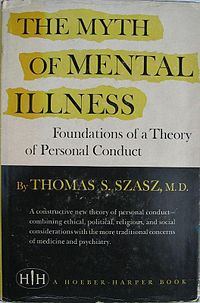
The Myth of Mental Illness: Foundations of a Theory of Personal Conduct is a 1961 book by the psychiatristThomas Szasz, in which the author criticises psychiatry and argues against the concept of mental illness.
It received much publicity, and has become a classic, well known as an argument that “mentally ill” is a label which psychiatrists have used against people “disabled by living” rather than truly having a disease.
Refer to:
Game theory: For Szasz, mental illness is best understood through the lens of game theory
Neurodiversity: A belief of promoting the acceptance of numerous different brain types typically considered to be mental disorders or illnesses by the scientific community
Background
Szasz writes that he became interested in writing The Myth of Mental Illness in approximately 1950, when, having become established as a psychiatrist, he became convinced that the concept of mental illness was vague and unsatisfactory. He began work on the book in 1954, when he was relieved of the burdens of a full-time psychiatric practice by being called to active duty in the navy. Later in the 1950s, it was rejected by the first publisher to whom Szasz submitted the manuscript. Szasz next sent the manuscript to Paul Hoeber, director of the medical division of Harper & Brothers, who arranged for it to be published.
Summary
Szasz argues that it does not make sense to classify psychological problems as diseases or illnesses, and that speaking of “mental illness” involves a logical or conceptual error. In his view, the term “mental illness” is an inappropriate metaphor and there are no true illnesses of the mind. His position has been characterised as involving a rigid distinction between the physical and the mental.
The legitimacy of psychiatry is questioned by Szasz, who compares it to alchemy and astrology, and argues that it offends the values of autonomy and liberty. Szasz believes that the concept of mental illness is not only logically absurd but has harmful consequences: instead of treating cases of ethical or legal deviation as occasions when a person should be taught personal responsibility, attempts are made to “cure” the deviants, for example by giving them tranquilisers. Psychotherapy is regarded by Szasz as useful not to help people recover from illnesses, but to help them “learn about themselves, others, and life.” Discussing Jean-Martin Charcot and hysteria, Szasz argues that hysteria is an emotional problem and that Charcot’s patients were not really ill.
Reception
The Myth of Mental Illness received much publicity, quickly became a classic, and made Szasz a prominent figure. The book was reviewed in the American Journal of Psychiatry, Journal of Nervous and Mental Disease, Psychosomatic Medicine, Archives of General Psychiatry, Clinical Psychology Review, and Psychologies. Published at a vulnerable moment for psychiatry, when Freudian theorizing was just beginning to fall out of favour and the field was trying to become more medically oriented and empirically based, the book provided an intellectual foundation for mental patient advocates and anti-psychiatry activists. It became well known in the mental health professions and was favourably received by those sceptical of modern psychiatry, but placed Szasz in conflict with many doctors. Soon after The Myth of Mental Illness was published, the Commissioner of the New York State Department of Mental Hygiene demanded, in a letter citing the book, that Szasz be dismissed from his university position because he did not accept the concept of mental illness.
The philosopher Karl Popper, in a 1961 letter to Szasz, called the book admirable and fascinating, adding that, “It is a most important book, and it marks a real revolution.” The psychiatrist David Cooper wrote that The Myth of Mental Illness, like the psychiatrist R.D. Laing’s The Divided Self (1960), proved stimulating in the development of anti-psychiatry, though he noted that neither book is itself an anti-psychiatric work. He described Szasz’s work as “a decisive, carefully documented demystification of psychiatric diagnostic labelling in general.” Socialist author Peter Sedgwick, writing in 1982, commented that in The Myth of Mental Illness, Szasz expounded a “game-playing model of social interaction” which is “zestful and insightful” but “neither particularly uncommon nor particularly iconoclastic by the standards of recent social-psychological theorising.” Sedgwick argued that many of Szasz’s observations are valuable regardless of the validity of Szasz’s rejection of the concept of mental illness, and could easily be accepted by psychotherapists. Although agreeing with Szasz that the assignation of mental illness could undermine individual responsibility, he noted that this did not constitute an objection to the concept itself.
The philosopher Michael Ruse called Szasz the most forceful proponent of the thesis that mental illness is a myth. However, while sympathetic to Szasz, he considered his case over-stated. Ruse criticized Szasz’s arguments on several grounds, maintaining that while the concepts of disease and illness were originally applied only to the physiological realm, they can properly be extended to the mind, and there is no logical absurdity involved in doing so. Kenneth Lewes wrote that The Myth of Mental Illness is the most notable example of the “critique of the institutions of psychiatry and psychoanalysis” that occurred as part of the “general upheaval of values in the 1960s”, though he saw the work as less profound than Michel Foucault’s Madness and Civilization (1961).
The psychiatrist Peter Breggin called The Myth of Mental Illness a seminal work. The author Richard Webster described the book as a well known argument against the tendency of psychiatrists to label people who are “disabled by living” as mentally ill. He observed that while some of Szasz’s arguments are similar to his, he disagreed with Szasz’s view that hysteria was an emotional problem and that Charcot’s patients were not genuinely mentally ill. The lawyer Linda Hirshman wrote that while few psychiatrists adopted the views Szasz expounded in The Myth of Mental Illness, the book helped to encourage a revision of their diagnostic and therapeutic claims. The historian Lillian Faderman called the book the most notable attack on psychiatry published in the 1960s, adding that “Szasz’s insights and critiques would prove invaluable to the homophile movement.”
GROW is a peer support and mutual-aid organisation for recovery from, and prevention of, serious mental illness. GROW was founded in Sydney, Australia in 1957 by Father Cornelius B. “Con” Keogh, a Roman Catholic priest, and psychiatric patients who sought help with their mental illness in Alcoholics Anonymous (AA).
Consequently, GROW adapted many of AA’s principles and practices. As the organisation matured, GROW members learned of Recovery International, an organisation also created to help people with serious mental illness, and integrated pieces of its will-training methods. As of 2005 there were more than 800 GROW groups active worldwide. GROW groups are open to anyone who would like to join, though they specifically seek out those who have a history of psychiatric hospitalisation or are socioeconomically disadvantaged. Despite the capitalisation, GROW is not an acronym. Much of GROW’s initial development was made possible with support from Orval Hobart Mowrer, Reuben F. Scarf, W. Clement Stone and Lions Clubs International.
Processes
GROW’s literature includes the Twelve Stages of Decline, which indicate that emotional illness begins with self-centeredness, and the Twelve Steps of Personal Growth, a blend of AA’s Twelve Steps and will-training methods from Recovery International. GROW members view recovery as an ongoing life process rather than an outcome and are expected to continue following the Steps after completing them in order to maintain their mental health.
The Twelve Stages of Decline
We gave too much importance to ourselves and our feelings.
We grew inattentive to God’s presence and providence and God’s natural order in our lives.
We let competitive motives, in our dealings with others, prevail over our common personal welfare.
We expressed our suppressed certain feelings against the better judgement of conscience or sound advice.
We began thinking in isolation from others, following feelings and imagination instead of reason.
We neglected the care and control of our bodies.
We avoided recognising our personal decline and shrank from the task of changing.
We systematically disguised in our imaginations the real nature of our unhealthy conduct.
We became a prey to obsessions, delusions and hallucinations.
We practised irrational habits, under elated feelings of irresponsibility or despairing feelings of inability or compulsion.
We rejected advice and refused to co-operate with help.
We lost all insight into our condition.
The Twelve Steps of Recovery and Personal Growth
We admitted to personal disorder in our lives.
We firmly resolved to restore order in our lives and co-operated with the help that we needed.
We surrendered to the healing power God or We surrendered to the healing power of truth.
We made personal inventory and accepted ourselves.
We made moral inventory and cleaned out our hearts.
We endured until ‘cured’.
We took care and control of our bodies.
We learned to think by reason rather than by feelings and imagination.
We trained our wills to regulate our feelings.
We took our responsible and caring place in the wider community.
We grew daily closer to maturity.
We carried GROW’s hopeful, healing, and transforming message to others in need.
GROW suggests atheists and agnostics use “We became inattentive to objective natural order in our lives” and “We trusted in a health-giving power in our lives as a whole” for the Second Stage of Decline and Third Step of Personal Growth, respectively.
Results of Qualitative Analysis
Statistical evaluations of interviews with GROW members found they identified self-reliance, industriousness, peer support, and gaining a sense of personal value or self-esteem as the essential ingredients of recovery. Similar evaluations of GROW’s literature revealed thirteen core principles of GROW’s program. They are reproduced in the list below by order of relevance, with a quote from GROW’s literature, explaining the principle.
Be Reasonable: “We learned to think by reason rather than by feelings and imagination.”
Decentralize, participate in community: “…decentralization from self and participation in a community of persons is the very process of recovery or personal growth.”
Surrender to the Healing Power of a wise and loving God: “God, who made me and everything connected with me, can overcome any and every evil that affects my life.”
Grow Closer to Maturity: “Maturity is a coming to terms with oneself, with others, and with life as a whole.”
Activate One’s Self to Recover and Grow “Take your fingers off your pulse and start living.”
Become Hopeful: “I can, and ultimately will, become completely well; God who made me can restore me and enable me to do my part. The best in life and love and happiness is ahead of me.”
Settle for Disorder: “Settle for disorder in lesser things for the sake of order in greater things; and therefore be content to be discontent in many things.”
Be Ordinary: “I can do whatever ordinary good people do, and avoid whatever ordinary good people avoid. My special abilities will develop in harmony only if my foremost aim is to be a good ordinary human being.”
Help Others: We carried the GROW message to others in need.
Accept One’s Personal Value: “No matter how bad my physical, mental, social or spiritual condition I am always a human person, loved by God and a connecting link between persons; I am still valuable, my life has a purpose, and I have my unique place and my unique part in my Creator’s own saving, healing and transforming work.”
Use GROW: “Use the hopeful and cheerful language of GROW.”
Gain Insight: “We made moral inventory and cleaned out our hearts.”
Accept Help: “We firmly resolved to get well and co-operated with the help that we needed.”
Effectiveness
Participation in GROW has been shown to decrease the number of hospitalisations per member as well as the duration of hospitalisations when they occur. Members report an increased sense of security and self-esteem, and decreased anxiety. A longitudinal study of GROW membership found time involved in the programme correlated with increased autonomy, environmental mastery, personal growth, self-acceptance and social skills. Women in particular experience positive identity transformation, build friendships and find a sense of community in GROW groups.
Literature
The Programme of Growth to Maturity, generally referred to as the ‘Blue Book’, is the principal literature used in GROW groups. The book is divided into three sections based on the developmental stages of members: ‘Beginning Growers’, ‘Progressing Growers’ and ‘Seasoned Growers’. Additionally, there are three related books written by Cornelius B. Keogh, and one by Anne Waters, used in conjunction with the Blue Book.
GROW (1983). GROW: World Community Mental Health Movement: The Program of Growth to Maturity (the “Blue Book”). Sydney, Australia: GROW Publications. OCLC 66288113.
Keogh, Cornelius B. (1975). Readings for mental health (the “Brown Book”). Sydney, Australia: GROW Publications. ISBN 0-909114-00-5. OCLC 47699449.
Keogh, Cornelius B.; GROW (Australia) (1967). Readings for recovery (the “Red Book”). Sydney Australia: GROW. OCLC 154602570.
Keogh, Cornelius B. (1967). Recovery. Sydney, Australia. OCLC 57499165.
Waters, Anne (2005). GROWing to Maturity: A Potpourri of Readings for Mental Health (the “Lavender Book”). GROW in Ireland Ltd. ISBN 0-9529198-2-6.
In psychiatry, stilted speech or pedantic speech is communication characterised by situationally-inappropriate formality (refer to Communication Deviance). This formality can be expressed both through abnormal prosody as well as speech content that is “inappropriately pompous, legalistic, philosophical, or quaint”. Often, such speech can act as evidence for autism spectrum disorder (ASD) or a thought disorder, a common symptom in schizophrenia or schizotypal personality disorder.
To diagnose stilted speech, researchers have previously looked for the following characteristics:
Speech conveying more information than necessary.
Vocabulary and grammar expected from formal writing rather than conversational speech.
Unneeded repetition or corrections.
While literal and long-winded word content is often the most identifiable feature of stilted speech, such speech often displays irregular prosody, especially in resonance. Often, the loudness, pitch, rate, and nasality of pedantic speech vary from normal speech, resulting in the perception of pedantic or stilted speaking. For example, overly loud or high-pitched speech can come across to listeners as overly forceful while slow or nasal speech creates an impression of condescension.
These attributions, which are commonly found in patients with ASD, partially account for why stilted speech has been considered a diagnostic criterion for the disorder. Stilted speech, along with atypical intonation, semantic drift, terseness, and perseveration, are all qualities known to be commonly impaired during conversation with adolescents on the autistic spectrum. Often, stilted speech found in children with ASD will also be especially stereotypic or rehearsed.
Patients with schizophrenia are also known to experience stilted speech. This symptom is attributed to both an inability to access more commonly used words and a difficulty understanding pragmatics – the relationship between language and context. However, stilted speech appears as a less common symptom compared to a certain number of other symptoms of the psychosis. This element of cognitive disorder is also exhibited as a symptom in the narcissistic personality disorder.
There is disagreement on the definition of psychophenomenology within the discipline of psychiatry, e.g. published sources provide definitions that are “various and sometimes conflicting (Rule 2005)”.
The Research Diagnostic Criteria (RDC) are a collection of influential psychiatric diagnostic criteria published in late 1970s under auspices of Statistics Section NY Psychiatric Institute, authors were Spitzer, R L; Endicott J; Robins E. PMID 1153649; As psychiatric diagnoses widely varied especially between the USA and Europe, the purpose of the criteria was to allow diagnoses to be consistent in psychiatric research.
Some of the criteria were based on the earlier Feighner Criteria, although many new disorders were included; “The historical record shows that the small group of individuals who created the Feighner criteria instigated a paradigm shift that has had profound effects on the course of American and, ultimately, world psychiatry.”
The RDC is important in the history of psychiatric diagnostic criteria as the DSM-III was based on many of the RDC descriptions, head of DSM III Edition was R L Spitzer.
The Chinese Society of Psychiatry (CSP; Chinese: 中华医学会精神病学分会; lit. ‘Chinese Medical Association Psychiatry Branch’) is the largest organisation for psychiatrists in China.
It publishes the Chinese Classification of Mental Disorders (“CCMD”), first published in 1985. The CSP also publishes clinical practice guidelines; promotes psychiatric practice, research and communication; trains new professionals; and holds academic conferences.
Origins and Organisation
The organisation developed out of the Chinese Society of Neuro-Psychiatry, which was founded in 1951. This separated into the Chinese Society of Psychiatry and Chinese Society of Neurology in 1994. Since then, successive committees have run the organisation, currently the 3rd Committee, which started in 2003, whose president is Dongfeng Zhou. The CCMD is now on its third revision.
The official journal of the CSP is the Chinese Journal of Psychiatry (中华精神科杂志).[2] The Society held its seventh annual academic conference in 2006. The Society is a member of the World Psychiatric Association.
As of 2005, the CSP had 800 members.
Brief History
In 2001, the CSP declassified homosexuality and bisexuality as a mental disorder. However, the organization specified that, “although homosexuality was not a disease, a person could be conflicted or suffering from mental illness because of their sexuality, and that condition could be treated”, according to Damien Lu, founder of the Information Clearing House for Chinese Gays and Lesbians. Reportedly, this loophole is used to promote conversion therapy in China.
Beginning in 2014, the CSP began collaborating with the McLean Hospital. The purpose of the programme is to share research cross-culturally between specialists in psychotic and mood disorders.
Controversy
The Chinese Society of Psychiatrists (CSP) has been criticised for alleged complicity in the government’s political abuse of psychiatry towards Falun Gong practitioners – including by detaining individuals via diagnosing adherents as “political maniacs” or with “Qi Gong psychosis”. Antipsychotic drugs were wrongly prescribed to practitioners.
In 2004, the CSP agreed on a joint response with the World Psychiatric Association to the allegations. According to the CSP, certain psychiatrists had “failed to distinguish between spiritual-cultural beliefs and delusions” due to “lack of training and professional skills”, and this led to misdiagnoses. However, they claimed this was not a systematic issue and invited the WPA to correct the problem.
The WPA stated, “What has become clear… has been the need to assist Chinese colleagues in matters concerning forensic psychiatry, medical ethics, patients’ rights, mental health legislation, diagnosis and classification, to help them improve the care of mentally ill in China and prevent future abuses.” Arthur Kleinman, a psychiatrist at Harvard University, said he believed the claims about systematic abuse of psychiatry were exaggerated, while acknowledging that it did occur in some cases. Abraham Halpern, a psychiatrist at New York Medical College and board member of the Friends of Falun Gong, USA, criticised the WPA for not demanding an investigative mission in China.
A follow-up review of the controversy was written by Alan A. Stone, a professor of psychiatry and president of the American Psychiatric Association, and published in the Psychiatric Times. Stone determined that psychiatrists in China were generally poorly trained and did not receive the sort of medical training which was standard in the West. Stone said this was cause for the misdiagnoses.
Haltlose personality disorder is a personality disorder in which affected individuals possess psychopathic traits built upon short-sighted selfishness and irresponsible hedonism, combined with an inability to anchor one’s identity to a future or past. The symptoms of Haltlose are characterised by a lack of inhibition.
Refer to Hysteroid Dysphoria. Other names have included Willenloser Psychopath, Unstable Psychopath, Unstable Drifter, and Disinhibited Personality.
Described by Emil Kraepelin and Gustav Aschaffenburg in the early twentieth century, and further distinguished by Karl Jaspers, Eugen and Manfred Bleuler, it has been colloquially dubbed psychopathy with an “absence of intent or lack of will”.
With other hyperthymics, Haltlose personalities were considered to make up “the main component of serious crime”, and are studied as one of the strains of psychopathy relevant to criminology as they are “very easily involved in the criminal history” and may become aggressors or homicidal. Their psychopathy is difficult to identify as a shallow sense of conformity is always present. A 2020 characterisation of mental illnesses noted of the Haltlose that “these people constantly need vigilant control, leadership, authoritarian mentor, encouragement and behavior correction” to avoid an idle lifestyle, involvement in antisocial groups, crime and substance abuse. The marked tendencies towards suggestibility are off-set by demonstrations of “abnormal rigidity and intransigence and firmness”.
After discovering a guilty conscience due to some act or omission they have committed, “they then live under constant fear of the consequences of their action or inaction, fear of something bad that might strike them” in stark opposition to their apparent carelessness or hyperthymic temperament, which is itself frequently a subconscious reaction to overwhelming fear. They frequently withdraw from society. Given their tendency to “exaggerate, to embroider their narratives, to picture themselves in ideal situations, to invent stories”, this fear then manifests as being “apt to blame others for their offences, frequently seeking to avoid responsibility for their actions”. They do not hold themselves responsible for their failed life, instead identifying as an ill-treated martyr.
They were characterised as Dégénérés supérieurs, demonstrating normal or heightened intellect but degraded moral standards. Of the ten types of psychopaths defined by Schneider, only the Gemütlose (compassionless) and the Haltlose “had high levels of criminal behavior” without external influence, and thus made up the minority of psychopaths who are “virtually doomed to commit crimes” by virtue only of their own constitution. Frequently changing their determined goals, a haltlose psychopath is “constantly looking for an external hold, it doesn’t really matter whether they join occult or fascist movements”. The ability to moderate external influence was considered one of three characteristics necessary to form an overall personality, thus leaving Haltlose patients without a functional personality of their own. A study of those with haltlose personality disorder concludes “In all of those cases, the result was a continuous social decline that ended in asocial-parasitic existence or an antisocial-criminal life”.
Haltlose has one of the most unfavourable prognoses of psychopathies. To exist safely, such a psychopath requires “a harsh lifestyle” and constant supervision.
Etymology and Criticism
“Haltlos” is a German word that contextually refers to a floundering, aimless, irresponsible lifestyle, and the diagnosis is named “Haltlose” using the feminine variation on the word. They are commonly clinically termed an “unstable psychopath”, which is differentiated from emotionally unstable personality disorder (an alternative name for borderline personality disorder). It was remarked in early studies that England, the United States and northern European countries did not use the same typology, not distinguishing between those psychopaths who were unstable and those who were “Unstable Psychopaths”.
It has been dubbed a part of “German-speaking psychiatry”. The term “Haltlose” is more common in the study of psychiatry, while “Willenlose” is preferred in sociology. Some like Karl Birnbaum prefer the term “Haltlose”, while others like Kurt Schneider prefer “Willenlos” shifting focus off their lack of self-control and opposed to the moralist tones of those like Birnbaum who had described the Haltlose as unable to grasp “important ideal values such as honor and morality, duty and responsibility, as well as material ones such as prosperity and health”. In 1928, Eugen Kahn argued Willenlose was a misnomer, as the patients demonstrated plenty of “will” and simply lacked the ability to translate it into action. Historically, researchers such as Schneider argued that instability is the symptom, whereas lack of volition is the underlying cause. It is not included in the Diagnostic and Statistical Manual of Mental Disorders (DSM), possibly due to a modern belief that the concept of volition is outdated and overshadowed by the concepts of motivation and arousal or drive.
In 1963, Karl Jaspers defined the term as “those who have no willpower at all, the drifters, simply echoing any influence that impinges on them”. However, in 1976, the Government of Canada listed the alternate term “Unstable drifter” in a psychiatric criminology context as a problematic term for which they could not readily offer a French translation in accordance with their bilingualism laws. Similar issues have arisen trying to translate it to other languages, including Turkish. Ultimately the diagnosis was handicapped by the issues of translation, leading to criticism of “the impoverishment of psychiatric vocabulary” that led to declining research and use.
In the early 20th century, Aschaffenburg distanced himself from accusations that the diagnosis was intended to protect criminals from punishment, emphasizing instead that those with Haltlose personality disorder “generally cannot be exculpated”.
Dr. Friedrich Stumpfl cautioned against what he saw as a trend of diagnosing haltlose personality disorder without investigating comorbidities that may be even more pronounced. In condemning the idea of personality disorders generally, Joachim-Ernst Meyer suggested in 1976 that Schneider’s early description of the Haltlose personality disorder, as a lack of determination in aspects of life including parenting, could just as easily be described as an example of a neurosis rather than a psychopathy if studied only by its aetiology rather than its symptoms, and used it as an example of the nature versus nurture debate that surrounded all personality disorders. Critics ceded that the term “Haltlose” remained of value in educational and therapeutic contexts, while suggesting future collaboration between psychiatric research and sociologists would allow further definition.
Recently, it has been criticised as a “diagnosis of convenience [that] avoids all further deliberations about a psychopathic personality”. Dr. DM Svrakic and Dr. M Divac-Jovanovic suggested the ICD-10 explanations of Haltlose, Immature and Psychoneurotic personality disorders appeared “dubious”, and sociologist James Cosgrave found psychiatric use to represent a “fringe figure”. A graduate student at Bochumer Stadt & Studierendenzeitung condemned the historical diagnosis from an LGBT perspective, opining that “incredibly oppressive language” had been used by the psychiatrists studying it such as “pathological femininity”.
It may be that the evolution of test-batteries have minimised diagnoses of Haltlosen, differentiating it from some newer models in psychiatry.
Physiology
Described as bearing a “pronounced heredity burden”, the propensity for Haltlose has also been suggested to be passed only through the maternal genes. Only able to offer “primitive reactions” and “poor and immature judgement”, they are noted to display an absolute lack of purpose in their lives “except for the simple biological need to continue living”.
Gustav von Bergmann, a specialist in internal medicine rather than psychiatry, wrote in 1936 that Haltlose personality disorder was entirely biological rather than fostered through psychological experiences. Indeed, Dr. Hans Luxenburger proposed in 1939 that a toxin in the metabolism, when present with Haltlose personality disorder, might be responsible for asthenic difficulties such as shortness of breath, nausea, and cluster headaches. Dr. E.H. Hughes noted that two-thirds of Huntington’s disease patients had previously been diagnosed as Haltlose or Gemütlose psychopaths.
A study in 1949 of different psychopathies under examination by electroencephalography recordings showed that borderline personalities and haltlose personalities had increased levels of dysrhythmia, whereas other subtypes of psychopathy did not show variation. An individual in 1931 was noted as having initially improved but relapsed “because of encephalitis”. As with other personality disorders, a 1923 article suggests it can also be acquired through encephalitis. In 2006, an Essex warehouse employee who suffered head injuries was awarded £3 million compensation on the basis it had caused him to develop Haltlose personality disorder, seeking out prostitutes and pornography which destroyed his marriage.
Mistakes cannot be fully avoided when placing children under care. even an experienced specialist often cannot distinguish between a blossoming hebephrenia and a Gemutlose or Haltlose personality disorder. Even with weeks of institutional observation, the certainty of our diagnostic aids can remain doubtful…under certain circumstances a doctor will advise medical care even at the risk of learning the patient cannot improve as a result of mental illness and will end up in a madhouse. Kurt Schneider.
Dr. W. Blankenburg posited in 1968 that those with haltlose personality disorder exhibited less categorical orientation than those patients who were simply unstable. By 1962, lobotomy was being tested as a possible means to limit the chaotic thinking of the Haltlose personality.
Kraepelin, in noting “an increased risk of criminal behavior”, estimated that 64% of men and 20% of women with Haltlose descended into alcoholism in the early twentieth century. The frequent intersection between HLPD and alcoholism means modern clinical researchers may use “haltlose” as a grouping when separating subjects by disposition. Research in 1915 noted an increased propensity for lavish spending, and overconsumption of coffee, tea and medication.
One 1954 study suggested female Haltlose patients may experience “manic excitement” during their menses. According to 1949 research, they have a higher rate of homosexuality, and 1939 evidence suggested that masturbation is more prevalent in Haltlose and Gemütlose (compassionless) psychopaths than in other disorders, and Haltlose erethics leave them “usually very sexually excited” and seeking out “atypical, irregular and unusual” debauchery whether in brothels, adultery or destroying marriages.
They demonstrate similarities to hysteroid dysphoria. In 1928, it was proposed that Fantasy prone personality was likely a subset of Haltlose personalities, suffering from maladaptive daydreaming and Absorption.
The eugenicist Verners Kraulis of the University of Latvia noted it was frequently comorbid with Histrionic personality disorder.
Symptoms
According to 1968 research, haltlose personality disorder is frequently comorbid with other mental health diagnoses, and rarely appears isolated on its own. Hans Heinze focused on his belief that Haltlose ultimately stemmed from a sense of inferiority, while Kramer held there was a battling inferiority complex and superiority complex.
The Haltlose were said to have a dynamic instinctual drive to “cling” to others, to avoid a horrible loneliness they fear – but they will always represent a “lurking danger” because they were unable to actually maintain the necessary relationship and were in a class with the “forever abandoned”. According to 1926 research, they view all interaction as a means of winning “indulgence from some people, help from other people”.
One early study indicated that 7.5% of psychopaths were Haltlose, and Kraepelin estimated that his own practice determined fewer than 20% of psychopaths he saw were Haltlose. However more recent studies, after differentiating out newer diagnoses, have suggested that it may be fewer than 1% of psychopaths who are truly Haltlose.
Described in 1922 as both “moody” and “passive”, they quickly switch from over-confidence in victory to sullen defiance.
Their emotional lability means they alternate between projecting an optimistic and competent image claiming they are “destined to do great things”, and a more honest cynicism and depression. Research in 1925 indicates they display “great emotional irritability, which may result in violent loss of temper…and interpret every limitation as an undeserved insult” and have a “pronounced lust for argument”. The symptoms are considered to worsen if patients are granted greater independence “in the home and in their work”.
Their self schema only encompasses the immediate present. They are described as “living in a random location and moment”. A common pitfall in therapy is that they proved in 1917 to be “very superficial, they easily acquire knowledge but do not apply it in any way and soon forget it”.
The essence of these people…playthings of external influences, allowing themselves to be carried away by events like a leaf in the wind! …Impermanence is everything. In one hour, they are happy and excited with the whole world lying open for them in the splendor of the joy of life, but the next hour casts aside this optimism and the future now seems bleak, gray on gray…sympathies and antipathies quickly replace each other, what was worshipped yesterday is burned today, and despite all oaths of eternal loyalty, the best friend is transformed into the deeply-loathed enemy overnight.” Dr. L. Scholz, Anomale Kinder, Berlin, 1919.
Those with HLPD display “a number of endearing qualities, charming with an apparent emotional warmth, but also an enhanced suggestibility and a superficiality of affect”, which can lead to unrealistic optimism. and “wandering through life without ever taking firm root”. They are also noted as “absolutely indifferent to others…likes to live for [their] pleasure today, does not make plans not only for the future but even for tomorrow, studying and working are not for them”. Persons with HLPD typically lack any deep knowledge, and “look for easy life and pleasures”. They have been described as “conquerers with an appearance of emotional warmth”.
Persons with HLPD were noted as struggling with hypochondria in 1907. They also struggle with alcoholism, and identify with antisocial personality disorder.
Kraepelin said they were “apt to take senseless journeys, perhaps even becoming vagabonds”. Kraepelin argued only lifelong wanderlust was tied to Haltlose, whereas Kahn argued that the Haltlose often lost their wanderlust as they aged and preferred to settle into mediocrity. Some make their fortune, but the disappearance of less fortunate travelers is not mentioned by their families who considered them to have been burdensome.
To early twentieth-century researchers, they appeared amiable, well-spoken, self-confident and to be making strong efforts to improve their weaknesses, thus making a misleading first impression and endearing themselves to superiors. The lack of a sense of identity, or internal support, was thought to a lack of resistance to both external and internal impulses in 1927. Their “gradual deterioration in the swamp of neediness and immorality” still does not make a lasting impression on the patients. Thus Haltlose patients who recognize their shortcomings were thought to possibly be overwhelmed by a subconscious fear about participating in the world without restraints in a 1924 account. Similarly, researchers in the early twentieth-century believed that the inauthenticity of their projected self and superficiality of knowledge means that when “someone who is really superior to [them]”, after a period of stiffly asserting themselves hoping to avoid submission, will ultimately and without explanation fully embrace the position of the other.
Pathological lying is closely linked to Haltlose personality disorder, with Arthur Kielholz noting “They lie like children…this activity always remains just a game which never satisfies them and leaves them with a guilty conscious because neither the super ego nor the Id get their due…Since they are offering such a daydream as a gift, they consider themselves entitled to extract some symbolic gift in return through fraud or theft”. Adler maintained “Memory is usually poor and untrustworthy…often they seem to have no realization of the truth”, while Homburger felt they held “no sense of objectivity, no need for truth or consistency”.
According to early accounts, choices are made, often in mirroring others around them, but “do not leave even a passing imprint on the person’s identity”. Thus, they can “behave properly for a while under good leadership”, and are not to be trusted in leadership positions themselves. Gannushkin noted they must be urged, scolded or encouraged “with a stick, as they say”. They demonstrate poor mood control and “react quickly to immediate circumstances” since “mood variation can be extreme and fluctuate wildly”, which led to the denotation “unstable psychopath”.
They have been described as “cold-blooded”, but must be differentiated from dependent personality disorder, as the two can appear similar, due to the artifice of the Haltlose patient, despite having starkly opposing foundations. Persons with Dependent Personality Disorder are defined by a tendency to embarrassment, and submissiveness which are not genuine facets of those with Haltlose even if they mimic such. Haltlose was thus deemed the “more troublesome” personality in 1955.
Childhood Origins, and Later Role of Family
“Whomever is abandoned in youth to the inexorable misery of existence, and at the same time is exposed to all manner of seductions, will find it very difficult to curb their constantly incited desires, and to instead force themselves through to the lofty vantage of moral self-assertion. Kraepelin speaking about the Haltlose, 1915.
It has been proposed that haltlose personality disorder may arise from “traumatization through maternal indolence” or institutionalisation in early life, although without definite conclusion. It may present in childhood simply as a hypomanic reaction to the loss of a parent or incest object. They often display a fear of abandonment that appeared in childhood, a common borderline personality disorder symptom. Male Haltlose personalities may come out of families with a pampering, over-protective and domineering mother with a weak father. Homburger noted the “childhood and youth of the Haltlose are extraordinarily sad”. It is possible, but rare, for Haltlose personalities to develop within healthy family structures.
Gerhardt Nissen referenced the possibility of intrauterine factors in the shaping of anti-social behaviours in Haltlose psychopaths, while noting the concept of psychopathy had been so weakened in modern psychopathology as to be indistinguishable from other conditions. Others have suggested there is a strong heredity correlation, as the parents often also display Haltlose personality disorder, especially the mother. Raising a haltlose child can, in some cases, destroy the family structure by forcing relatives to take opposing positions, provoking disagreement and creating an atmosphere of bitterness and dejection. They have been clinically described as disappointments to their families, and are unable to feel actual love for their parents and are indifferent to the hardships of relatives – since all relationships are seen only as potential means towards acquiring pleasure.
Care must be taken in making Haltlose diagnoses of children, since “the traits of instability of purpose, lack of forethought, suggestibility, egoism and superficiality of affect…are to some extent normal in childhood”. Children with haltlose personality disorder demonstrate a marked milieu dependency, which may be a cause rather than effect of the Haltlose. It is of great importance that only children with Haltlose have peers and friends to surround themselves to try and learn associations and behaviours. They often become sexually active at a young age but delayed sexual maturity, and as adults retain a psychophysical infantilism. Regressive addictions amongst Haltlose psychopaths typically are infantile, and seek to replace the lost “dual union” arising from their parents’ rejection, and later morph into a focus on subjects including vengeance or sado-masochism.
The Russian storybook character Dunno has been noted as an example of a child with Haltlose personality disorder.
The age at which parents or professionals exhibited concern about psychopathy ranged; rarely even at a preschool age. Haltlose children confusingly tend to appear very strong-willed and ambitious, it is only as they age and the lack of perseverance becomes manifest that caretakers become puzzled by their “naughtiness” as it contradicts what had earlier appeared. This arises principally due to their rigid demands for short-term wishes being mistakenly interpreted as having a fixed purpose and persistence. Some patients later shown to be Haltlose, had shown neuropathic traits in childhood such as bedwetting and stuttering. They were also more likely to run away from their home, begin drinking before the socially acceptable age, and were afraid of punishment. Although struggling to make friends in young childhood, they find it easier as they age.
Kraepelin contended the disorder was “based on a biological predisposition” but also affected by factors such as childrearing practises, social position and state of the parental home. His analysis showed that 49% of diagnosed Haltlose had obvious parental issues such as alcoholism or personality disorders. A 1944 study of children produced by incest by Dr. Alfred Aschenbrenner found a high rate of Haltlose personality disorder, which he suggested might be explained as inherited from overly suggestive mothers. It is possible, although difficult, to diagnose from the age of five and presents one of the stronger psychiatric difficulties if present at such young age. It may be possible to prevent social failure “through welfare measures” akin to early intervention. Italian courts stressed mimicry of positive role models as a means to combat Haltlose youth who had fallen afoul of the law.
Schooling
Haltlose can cause educational difficulties, and if parents do not understand the peculiarities of their haltlose child, they may try to through good intentions to force the child into an educational regimen inappropriate for them, which then creates a feeling of isolation in the child which grows into a rebellious tendencies, “which turns out to be disastrous for further development”. Students with Haltlose personalities may prefer the arts over the sciences, since the former does not require a consistent sense of truth and entails less disciplined study. Given their inability to anchor a self-schema and tendency to play-act roles, the theatre and film have great attraction and influence over them.
With proper leadership and controls from teachers, they are able to become “model pupils” in terms of behaviour, although Schneider opined that it was worthless to educate an inability to learn from mistakes prevented actual education, and bemoaned that the late onset of anti-social behaviours kept the Haltlose in school when they might otherwise be removed. Walter Moos believed that Haltlose personality disorder and hyperthymia had shown itself to be contagious in rare cases, wherein classmates developed the same disorder from interaction with patients. Homburger argued for removing a Haltlose child from their family of origin as soon as the disorder was confirmed, to resettle in a rural educational centre.
Adolescence, Young Adulthood and Efforts to Intervene
When required to live independently, they “soon lose interest, become distracted and absent-minded, and commit gross errors and negligence”. Ruth von der Leyen noted that “every care provider, teacher and doctor knows the Haltlose Psychopath from their practice”, and remarked that caring for such a patient was made more difficult because of the need to lecture and intervene to enlist the psychopath’s cooperation in short-term improvements, despite being aware the psychiatric reports have determined such efforts are ultimately useless but should be practised regardless.
The tendency to accumulate debts while seeking pleasure or escaping responsibility is often the attributed cause for their descent into crime, although Kramer noted those who displayed “extreme dexterity, sufficient talent for imagination, and a tendency towards dishonesty” were able to find alternative sources of income without necessarily becoming criminal, although warned that “again and again, their debts have to be paid until the parents no longer can, or want to, do this and leave them to their selves”.
Gannushkin noted “Such people involuntarily evoke sympathy and a desire to help them, but the assistance rendered to them rarely lasts, so it is worth abandoning such people for a short while”. The wasted good intentions resulted in the summary:
“probably the most important function of the psychiatrist when dealing with these patients is to protect their relatives and friends from ruining themselves in hopeless attempts at reclamation. With most of these patients a time comes when the relatives will be best advised…to allow the patient to go to prison, or otherwise suffer unsheltered the consequences of his deeds.”
By contrast, others have advanced the “rather optimistic” belief that “a suitable [spouse]” or similar “strong-willed” relative could drastically improve the outcome of Haltlosen patients. This was echoed by Andrey Yevgenyevich Lichko who, while preferring the term “accentuation of character” to describe the psychopathy rather than “personality disorder”, noted “if they fall into the hands of a person with a strong will, for example a wife or husband, they can they live quite happily…but the guardianship must be permanent.”
Criminology
While some Haltlose have risen to the level of dangerous offenders multiple times over, it is more frequent that they attract attention early from their “vagabond” nature.
Heinrich Schulte, a wartime medical judge and consulting psychiatrist for the military, continued advocating for the sterilization of Haltlose and other “Schwachsinnigen” after the war’s end. In 1979, the Neue Anthropologie publication referred to a need to sterilize those like alcoholics, “who are often Haltlose psychopaths”, from bearing children, to reduce crime.
Although Kraepelin believed those with Haltlose personality disorder represented the antithesis of morality, there is not necessarily a tendency towards deliberate amorality among the demographic despite its frequent criminal violations since they may lack the ability to premeditate. But their demonstrated lack of self-control is “especially manifested in the sphere of morality”.
In 1935, it was estimated that 58% of recidivist criminals were diagnosed with Haltlose personality disorder, higher than any other personality disorder. More recently, Haltlose and Histrionic were the most common personality disorders found in female juvenile delinquents by forensic psychologists in Russia in the year 2000.
Domestic Violence, Incest and Molestation of Children
“[Patients resembling Haltlose] as a rule show little insight into the peculiarities of their conduct. They do not understand how they could have done these things, or they blame their relatives, neighbors and so forth”. Dr. Herman Morris Adler, 1917.
Although they enter relationships easily, Andrey Yevgenyevich Lichko contends they are not capable of actual loyalty or selfless love, and sex is treated as a form of entertainment rather than intimacy. They are therefore described as acting as “family tyrants”.
Although they may not qualify as “true” pedophiles, Haltlose personalities demonstrate an increased risk of sexually molesting children, since other potential victims would require the realisation of greater planning, but children are suggestible and easily overwhelmed.
A 1967 German study had suggested over 90% of adult-child incest offenders were diagnosed with Haltlose Personality Disorder. Female patients may also live vicariously through encouraging and directing the sexual lives of their daughters.
Drunk Driving, Hit-and-Run
Some Haltlose personalities are drawn towards dangerous driving habits “as a source of almost hedonist pleasure”. In 1949 the Automobil Revue proposed that additional tests should be necessary for Haltlose personalities to obtain a driver’s license. They have been known to steal cars to joyride at high speeds if they are not otherwise able to find satisfy their urge.
The American Journal of Psychiatry published a study of hit and run drivers in 1941, which showed 40% of drivers who fled the scene of a traffic accident tested positive for haltlose personality disorder. This was consistent with the earlier finding that Haltlose Personalities were among the most likely to attempt to flee if caught in commission of any crime.
Suicidality and Murder-Suicide
Research in the early twentieth century on suicidality among the Haltlose indicated several things: they chafe at the notion of any religion as it introduces unwanted inhibitions, especially against parasuicidal demonstrations; women Haltlose most frequently indicated suicidality was based upon fear of punishment or reproach, as well as the “excitement” of being institutionalised; and although frequently planning or attempting suicide, including through suicide pacts or murder suicide, Haltlose typically do not succeed since they lacked courage and were easily distracted.
Institutionalisation
Haltlose patients respond very well to institutionalization where their influences can be controlled, becoming “model inmates” of sanitariums even within hours of first arriving despite a chaotic life outside of the regimen, “but if you leave them, through good intentions, to their own devices – they don’t last long before collapsing their current state and being seduced back onto the wrong track”. Schneider recommended warning them “through punishing them” as it was the only control on their action. Bleuler said the court system needed to understand such persons were in “urgent need of inhibitions”.
Pyotr Gannushkin noted they joined military service due to peer pressure but given the lack of alcohol and stern, hard work required of them were able to function without their normal impairment. A 1942 study of the Wehrmacht found that only Haltlose and Schizoid were not measurable among soldiers despite their presence in the civilian population. A 1976 Soviet naval study came to similar conclusions.
Roth and Slater concluded “the treatment of such a personality is almost hopeless under the present ordering of society. Any treatment would…present difficulties…beyond the powers of these patients. The prospects of psychotherapy are forlorn and the best that can be obtained will be reached through social control.”
Some researchers suggest their moods and insufficient motivation will lead them to “vague feelings of fear and calamity…turning every little thing into big things, excitement, misinterpreting every harmless word, criticizing everything and commiting hostile acts”, and in some cases they look back with hindsight and regret the injustices they did. However Kramer held that when caught in wrongdoing, “we find them contrite, self-accusing and assuring that they will improve – but on closer inspection it is feigned and not sincere”.
Upon being confronted with their misdeeds, the Haltlose respond “with more or less superficial reasons to excuse them, they claim that their parents treated them incorrectly, that they were the victim of adverse circumstances, seduced by other people and misled. Other Haltlose, especially those with a strong intellect, make up a theoretical schema that would justify their actions.”
Examples
Kielholz, Arthur, Internationale Zeitschrift für Psychoanalyse XIX 1933 Heft 4, “Weh’dem der lugt! Beitrag zum problem der pseudologia phantastica”, an article on pathological lying in the Haltlose patients Max Specke, a Swiss charlatan with a penchant for melodramatic flair and Emil Schuldling, a habitual criminal with childhood sexual perversions
Story of Robert Wenger, who was diagnosed Haltlose and spent 54 years between institutions and prison for minor crimes until the documentary series Quer exposed his case, leading to an apology from politician Samuel Bhend in 1999.
Karl Hager, a habitual criminal diagnosed Haltlose who was frequently jailed for homosexual acts and was ultimately killed in Sachsenhausen concentration camp (in German)
Berlit, Berthold (December 1931). “Erblichkeitsuntersuchungen bei Psychopathen”. Zeitschrift für die gesamte Neurologie und Psychiatrie. 134(1), pp.382-498.
Article referencing Hermann Lederman, discharged from the Wehrmacht in 1940 having been diagnosed with Haltlose personality disorder and sent to Wehrmachtgefängnis Torgau
Dialogical Psychiatry: A Handbook For The Teaching And Practice Of Open Dialogue.
Author(s): Russell Razzaque.
Year: 2019.
Edition: First (1st).
Publisher: Omni House Books.
Type(s): Paperback and Kindle.
Synopsis:
This book is written for all of those who are searching for a more client driven, compassionate and relational approach to mental health services. Consultant Psychiatrist, Professor Russell Razzaque combines his experience as practitioner, trainer and researcher of Open Dialogue in this accessible guide to a more dialogical psychiatry.
Both thoughtful and eminently practical, this book outlines the operational changes and the cultural shift needed to deliver this promising approach which could fundamentally transform the way mental health services are delivered. If you’ve ever wondered what the future of mental health services can, and hopefully will, look like I encourage you to read this book and be inspired to be part of that change.
Cross-cultural psychiatry (also known as Ethnopsychiatry or transcultural psychiatry or cultural psychiatry) is a branch of psychiatry concerned with the cultural context of mental disorders and the challenges of addressing ethnic diversity in psychiatric services. It emerged as a coherent field from several strands of work, including surveys of the prevalence and form of disorders in different cultures or countries; the study of migrant populations and ethnic diversity within countries; and analysis of psychiatry itself as a cultural product.
The early literature was associated with colonialism and with observations by asylum psychiatrists or anthropologists who tended to assume the universal applicability of Western psychiatric diagnostic categories. A seminal paper by Arthur Kleinman in 1977 followed by a renewed dialogue between anthropology and psychiatry, is seen as having heralded a “new cross-cultural psychiatry”. However, Kleinman later pointed out that culture often became incorporated in only superficial ways, and that for example 90% of DSM-IV categories are culture-bound to North America and Western Europe, and yet the “culture-bound syndrome” label is only applied to “exotic” conditions outside Euro-American society. Reflecting advances in medical anthropology, DSM-5 replaced the term “culture-bound syndrome” with a set of terms covering cultural concepts of distress: cultural syndromes (which may not be bound to a specific culture but circulate across cultures); cultural idioms of distress (local modes of expressing suffering that may not be syndromes); causal explanations (that attribute symptoms or suffering to specific causal factors rooted in local ontologies); and folk diagnostic categories (which may be part of ethnomedical systems and healing practices).
Definition
Cultural psychiatry looks at whether psychiatric classifications of disorders are appropriate to different cultures or ethnic groups. It often argues that psychiatric illnesses represent social constructs as well as genuine medical conditions, and as such have social uses peculiar to the social groups in which they are created and legitimized. It studies psychiatric classifications in different cultures, whether informal (e.g. category terms used in different languages) or formal (for example the World Health Organisation’s ICD, the American Psychiatric Association’s DSM, or the Chinese Society of Psychiatry’s CCMD). The field has increasingly had to address the process of globalisation. It is said every city has a different culture and that the urban environment, and how people adapt or struggle to adapt to it, can play a crucial role in the onset or worsening of mental illness.
However, some scholars developing an anthropology of mental illness consider that attention to culture is not enough if it is decontextualised from historical events, and history in more general sense. An historical and politically informed perspective can counteract some of the risks related to promoting universalised ‘global mental health’ programmes as well as the increasing hegemony of diagnostic categories such as PTSD (Didier Fassin and Richard Rechtman analyse this issue in their book ‘The Empire of Trauma’). Roberto Beneduce, who devoted many years to research and clinical practice in West Africa (Mali, among the Dogon) and in Italy with migrants, strongly emphasizes this shift. Inspired by the thought of Frantz Fanon, Beneduce points to forms of historical consciousness and selfhood as well as history-related suffering as central dimensions of a ‘critical ethnopsychiatry’ or ‘critical transcultural psychiatry’.
Brief History
As a named field within the larger discipline of psychiatry, cultural psychiatry has a relatively short history. In 1955, a program in transcultural psychiatry was established at McGill University in Montreal by Eric Wittkower from psychiatry and Jacob Fried from the department of anthropology. In 1957, at the International Psychiatric Congress in Zurich, Wittkower organised a meeting that was attended by psychiatrists from 20 countries, including many who became major contributors to the field of cultural psychiatry: Tsung-Yi Lin (Taiwan), Thomas Lambo (Nigeria), Morris Carstairs (Britain), Carlos Alberto Seguin (Peru) and Pow-Meng Yap (Hong Kong). The American Psychiatric Association established a Committee on Transcultural Psychiatry in 1964, followed by the Canadian Psychiatric Association in 1967. H.B.M. Murphy of McGill founded the World Psychiatric Association Section on Transcultural Psychiatry in 1970. By the mid-1970s there were active transcultural psychiatry societies in England, France, Italy and Cuba. There are several scientific journals devoted to cross-cultural issues: Transcultural Psychiatry (est. 1956, originally as Transcultural Psychiatric Research Review, and now the official journal of the WPA Section on Transcultural Psychiatry), Psychopathologie Africaine (1965), Culture Medicine & Psychiatry (1977), Curare (1978), and World Cultural Psychiatry Research Review (2006). The Foundation for Psychocultural Research at UCLA has published an important volume on psychocultural aspects of trauma and most recently the landmark volumes entitled Formative Experiences: the Interaction of Caregiving, Culture, and Developmental Psychobiology edited by Carol Worthman, Paul Plotsky, Daniel Schechter and Constance Cummings. and Re-Visioning Psychiatry: Cultural Phenomenology, Critical Neuroscience, and Global Mental Health edited by Laurence J. Kirmayer, Robert Lemelson and Constance Cummings.
It is argued that a cultural perspective can help psychiatrists become aware of the hidden assumptions and limitations of current psychiatric theory and practice and can identify new approaches appropriate for treating the increasingly diverse populations seen in psychiatric services around the world. The recent revision of the nosology of the American Psychiatric Association, DSM-5, includes a Cultural Formulation Interview that aims to help clinicians contextualise diagnostic assessment. A related approach to cultural assessment involves cultural consultation which works with interpreters and cultural brokers to develop a cultural formulation and treatment plan that can assist clinicians.
Organisations
The main professional organisations devoted to the field are the WPA Section on Transcultural Psychiatry, the Society for the Study of Psychiatry and Culture, and the World Association for Cultural Psychiatry. Many other mental health organisations have interest groups or sections devoted to issues of culture and mental health.
There are active research and training programs in cultural psychiatry at several academic centres around the world, notably the Division of Social and Transcultural Psychiatry at McGill University, Harvard University, the University of Toronto, and University College London. Other organisations are devoted to cross-cultural adaptation of research and clinical methods. In 1993 the Transcultural Psychosocial Organisation (TPO) was founded. The TPO has developed a system of intervention aimed at countries with little or no mental health care. They train local people to become mental health workers, often using people who previously have provided mental health guidance of some kind. The TPO provides training material that is adapted to local culture, language and distinct traumatic events that might have occurred in the region where the organisation is operating. Avoiding Western approaches to mental health, the TPO sets up what becomes a local non-governmental organisation (NGO) that is self-sustainable, as well as economically and politically independent of any state. The TPO projects have been successful in both Uganda and Cambodia.
The biopsychiatry controversy is a dispute over which viewpoint should predominate and form a basis of psychiatric theory and practice.
The debate is a criticism of a claimed strict biological view of psychiatric thinking. Its critics include disparate groups such as the antipsychiatry movement and some academics.
Overview of Opposition to Biopsychiatry
Biological psychiatry or biopsychiatry aims to investigate determinants of mental disorders devising remedial measures of a primarily somatic nature.
This has been criticised by Alvin Pam for being a “stilted, unidimensional, and mechanistic world-view”, so that subsequent “research in psychiatry has been geared toward discovering which aberrant genetic or neurophysiological factors underlie and cause social deviance”. According to Pam the “blame the body” approach, which typically offers medication for mental distress, shifts the focus from disturbed behaviour in the family to putative biochemical imbalances.
Research Issues
2003 Status in Biopsychiatric Research
Biopsychiatric research has produced reproducible abnormalities of brain structure and function, and a strong genetic component for a number of psychiatric disorders (although the latter has never been shown to be causative, merely correlative). It has also elucidated some of the mechanisms of action of medications that are effective in treating some of these disorders. Still, by their own admission, this research has not progressed to the stage that they can identify clear biomarkers of these disorders.
Research has shown that serious neurobiological disorders such as schizophrenia reveal reproducible abnormalities of brain structure (such as ventricular enlargement) and function. Compelling evidence exists that disorders including schizophrenia, bipolar disorder, and autism to name a few have a strong genetic component. Still, brain science has not advanced to the point where scientists or clinicians can point to readily discernible pathologic lesions or genetic abnormalities that in and of themselves serve as reliable or predictive biomarkers of a given mental disorder or mental disorders as a group. Ultimately, no gross anatomical lesion such as a tumour may ever be found; rather, mental disorders will likely be proven to represent disorders of intercellular communication; or of disrupted neural circuitry. Research already has elucidated some of the mechanisms of action of medications that are effective for depression, schizophrenia, anxiety, attention deficit, and cognitive disorders such as Alzheimer’s disease. These medications clearly exert influence on specific neurotransmitters, naturally occurring brain chemicals that effect, or regulate, communication between neurons in regions of the brain that control mood, complex reasoning, anxiety, and cognition. In 1970, The Nobel Prize was awarded to Julius Axelrod, Ph.D., of the National Institute of Mental Health, for his discovery of how anti-depressant medications regulate the availability of neurotransmitters such as norepinephrine in the synapses, or gaps, between nerve cells. (American Psychiatric Association, Statement on Diagnosis and Treatment of Mental Disorders, 26 September 2003).
Focus on Genetic Factors
Researchers have proposed that most common psychiatric and drug abuse disorders can be traced to a small number of dimensions of genetic risk and reports show significant associations between specific genomic regions and psychiatric disorders. Though, to date only a few genetic lesions have been demonstrated to be mechanistically responsible for psychiatric conditions. For example, one reported finding suggests that in persons diagnosed as schizophrenic as well as in their relatives with chronic psychiatric illnesses, the gene that encodes phosphodiesterase 4B (PDE4B) is disrupted by a balanced translocation.
The reasons for the relative lack of genetic understanding is because the links between genes and mental states defined as abnormal appear highly complex, involve extensive environmental influences and can be mediated in numerous different ways, for example by personality, temperament or life events. Therefore, while twin studies and other research suggests that personality is heritable to some extent, finding the genetic basis for particular personality or temperament traits, and their links to mental health problems, is “at least as hard as the search for genes involved in other complex disorders.” Theodore Lidz and The Gene Illusion argue that biopsychiatrists use genetic terminology in an unscientific way to reinforce their approach. Joseph maintains that biopsychiatrists disproportionately focus on understanding the genetics of those individuals with mental health problems at the expense of addressing the problems of the living in the environments of some extremely abusive families or societies.
Focus on Biochemical Factors
The chemical imbalance hypothesis states that a chemical imbalance within the brain is the main cause of psychiatric conditions and that these conditions can be improved with medication which corrects this imbalance. In that, emotions within a “normal” spectrum reflect a proper balance of neurotransmitter function, but abnormally extreme emotions which are severe enough to impact the daily functioning of patients (as seen in schizophrenia) reflect a profound imbalance. It is the goal of psychiatric intervention, therefore, to regain the homeostasis (via psychopharmacological approaches) that existed prior to the onset of disease.
This conceptual framework has been debated within the scientific community, although no other demonstrably superior hypothesis has emerged. Recently, the biopsychosocial approach to mental illness has been shown to be the most comprehensive and applicable theory in understanding psychiatric disorders. However, there is still much to be discovered in this area of inquiry. As a prime example – while great strides have been made in the field of understanding certain psychiatric disorders (such as schizophrenia) others (such as major depressive disorder) operate via multiple different neurotransmitters and interact in a complex array of systems which are (as yet) not completely understood.
Reductionism
Niall McLaren emphasizes in his books Humanizing Madness and Humanizing Psychiatry that the major problem with psychiatry is that it lacks a unified model of the mind and has become entrapped in a biological reductionist paradigm. The reasons for this biological shift are intuitive as reductionism has been very effective in other fields of science and medicine. However, despite reductionism’s efficacy in explaining the smallest parts of the brain this does not explain the mind, which is where he contends the majority of psychopathology stems from. An example would be that every aspect of a computer can be understood scientifically down to the last atom; however, this does not reveal the program that drives this hardware. He also argues that the widespread acceptance of the reductionist paradigm leads to a lack of openness to self-criticism and therefore halts the very engine of scientific progress. He has proposed his own natural dualist model of the mind, the biocognitive model, which is rooted in the theories of David Chalmers and Alan Turing and does not fall into the dualist’s trap of spiritualism.
Economic Influences on Psychiatric Practice
American Psychiatric Association president Steven S. Sharfstein, M.D. has stated that when the profit motive of pharmaceutical companies and human good are aligned, the results are mutually beneficial for all. In that, “Pharmaceutical companies have developed and brought to market medications that have transformed the lives of millions of psychiatric patients. The proven effectiveness of antidepressant, mood-stabilising, and antipsychotic medications has helped sensitize the public to the reality of mental illness and taught them that treatment works[citation needed]. In this way, Big Pharma has helped reduce stigma associated with psychiatric treatment and with psychiatrists.” However, Sharfstein acknowledged that the goals of individual physicians who deliver direct patient care can be different from the pharmaceutical and medical device industry. Conflicts arising from this disparity raise natural concerns in this regard including:
A “broken health care system” that allows “many patients [to be] prescribed the wrong drugs or drugs they don’t need”;
“medical education opportunities sponsored by pharmaceutical companies [that] are often biased toward one product or another”;
“[d]irect marketing to consumers [that] also leads to increased demand for medications and inflates expectations about the benefits of medications”;
“drug companies [paying] physicians to allow company reps to sit in on patient sessions to learn more about care for patients.”
Nevertheless, Sharfstein acknowledged that without pharmaceutical companies developing and producing modern medicines – virtually every medical specialty would have few (if any) treatments for the patients that they care for.
Pharmaceutical Industry Influences in Psychiatry
Studies have shown that promotional marketing by pharmaceutical and other companies has the potential to influence physician decision making. Pharmaceutical manufacturers (and other advocates) would argue that in today’s modern world – physicians simply do not have the time to continually update their knowledge base on the status of the latest research and that by providing educational materials for both physicians and patients, they are providing an educational perspective and that it is up to the individual physician to decide what treatment is best for their patients. The idea of pure promotion (e.g. lavish dinners) is a remnant of bygone era. It has been replaced by educationally-based activities that became the basis for the legal and industry reforms involving physician gifts, influence in graduate medical education, physician disclosure of conflicts of interest, and other promotional activities.
In an essay on the effect of advertisements for marketed anti-depressants there is some evidence that both patients and physicians can be influenced by media advertisements and this has the possibility of increasing the frequency of certain medicines being prescribed over others.




 Mental Health Matters
You must be logged in to post a comment.