Book: Abnormal Psychology

Book Title:

Abnormal Psychology.

Author(s): Thomas F. Oltmanns and Robert E. Emery.

Year: 2019.

Edition: Ninth (9th).

Publisher: Pearson.

Type(s): Paperback.

Synopsis:

An overview of abnormal psychology that focuses not on “them,” but on all of us.

Abnormal Psychology brings both the science and personal aspects of the discipline to life with a focus on evidence-based practice and emerging research. Authors Thomas Oltmanns and Robert Emery cover methods and treatment in context in order to helps readers understand the biological, psychological, and social perspectives on abnormal psychology.

The 9th Edition has been updated to integrate coverage of the DSM-5, as well as the latest research and contemporary topics that will interest students.

On This Day … 01 October

People (Births)

  • 1940 – Phyllis Chesler, American feminist psychologist, and author of the best-seller, Women and Madness (1972).
  • 1950 – Susan Greenfield, Baroness Greenfield, English neuroscientist, academic, and politician.

Phyllis Chesler

Phyllis Chesler is an American writer, psychotherapist, and professor emerita of psychology and women’s studies at the College of Staten Island (CUNY).

She is known as a feminist psychologist, and is the author of 18 books, including the best-seller Women and Madness (1972), With Child: A Story of Motherhood (1979) and An American Bride in Kabul: A Memoir (2013). Chesler has written on topics such as gender, mental illness, divorce and child custody, surrogacy, second-wave feminism, pornography, prostitution, incest, and violence against women.

In more recent years, Chesler has written several works on such subjects as anti-Semitism, Islam, and honor killings. Chesler argues that many western intellectuals, including leftists and feminists, have abandoned Western values in the name of multicultural relativism, and that this has led to an alliance with Islamists, an increase in anti-Semitism, and to the abandonment of Muslim women and religious minorities in Muslim-majority countries.

Susan Greenfield

Susan Adele Greenfield, Baroness Greenfield, CBE, FRCP is an English scientist, writer, broadcaster, and member of the House of Lords. Her research has focused on the treatment of Parkinson’s disease and Alzheimer’s disease. She is also interested in the neuroscience of consciousness and the impact of technology on the brain.

Greenfield is a senior research fellow at Lincoln College, Oxford, and was a professor of Synaptic Pharmacology.

She was chancellor of Heriot-Watt University in Edinburgh between 2005 and 2013. From 1998 to 2010, she was director of the Royal Institution of Great Britain. In September 2013, she co-founded the biotech company Neuro-bio Ltd, where she is Chief Executive Officer.

Book: Psychology of the Future – Lessons from Modern Consciousness Research.

Book Title:

Psychology of the Future – Lessons from Modern Consciousness Research.

Author(s): Stanislav Grof.

Year: 2000.

Edition: First (1st), Illustrated Edition.

Publisher: State University of New York Press.

Type(s): Hardcover and Paperback.

Synopsis:

Summarizes Grof’s experiences and observations from more than forty years of research into non-ordinary states of consciousness.

This accessible and comprehensive overview of the work of Stanislav Grof, one of the founders of transpersonal psychology, was specifically written to acquaint newcomers with his work.

Serving as a summation of his career and previous works, this entirely new book is the source to introduce Grof’s enormous contributions to the fields of psychiatry and psychology, especially his central concept of holotropic experience, where holotropic signifies “moving toward wholeness.”

Grof maintains that the current basic assumptions and concepts of psychology and psychiatry require a radical revision based on the intensive and systematic research of holotropic experience. He suggests that a radical inner transformation of humanity and a rise to a higher level of consciousness might be humankind’s only real hope for the future.

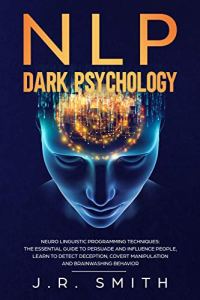
Book: NLP Dark Psychology

Book Title:

NLP Dark Psychology – Neuro-Linguistic Programming Techniques: The Essential Guide To Persuade and Influence People, Learn to Detect Deception, Covert Manipulation and Brainwashing Behaviour.

Author(s): J.R. Smith.

Year: 2020.

Edition: First (1st).

Publisher: Independently Published.

Type(s): Paperback, Audiobook, and Kindle.

Synopsis:

Has it come to your realisation that some people have the ability to dupe others using manipulative techniques and can as well get tricked by others using many secrets of dark psychology?

Some has the ability to victimise other people by preying on them. Whereas many restrain from this tendency, there are those who act on these instincts.

In this book you can discover Dark Psychology Techniques that are used by people to influence, manipulate, and coerce others to get whatsoever they want.

For so many years now, the concept of mind control has existed, and people have shown both fear and fascination of what would take place if an individual would control their thoughts and minds and lead them to do things that are against their wish and will.

There have been conspiracy theories on how government officials, as well as other influential persons, use their talents and capacities to control actions of the minorities and small groups.

Inside the book, you will come across interesting topics such as:

  • How We Receive Information.
  • The Animalistic Nature of the Brain.
  • The Dark Side of Manipulation.
  • How People Use Our Map of Reality Against Us.
  • Examples of Manipulation We Can Find in Our Day-To-Day Lives
  • Simple Mind Control Techniques to Use.
  • Personalities Likely to Manipulate.
  • Why Reframing is so Important.
  • NLP and Depression.
  • NLP and Anxiety.
  • Different Ways That You Are Persuaded Subliminally.

This is just a tiny fraction of what you will discover

Each of the mind control tactics works in a different way.

In the modern world, dark psychology is among the most powerful forces used by the most influential people to manipulate others.

People who are uninformed are in the danger of having it used against them.

Just imagine how different your life would be if you could get prospective customers, colleagues, employees, investors, friends, and literally anyone to do what you want them to do without you having to beg, cajole, or threaten.

So even if you have tried to learn these skills before but still feel lost and frustrated, this guide will give you the practical tools and knowledge to read and understand people in a way few others ever will.

Book: New Handbook of Mathematical Psychology – Volume 02

Book Title:

New Handbook of Mathematical Psychology – Volume 02: Modelling and Measurement.

Author(s): William H. Batchelder, Hans Colonius, and Ehtibar N. Dzhafarov (Editors).

Year: 2018.

Edition: First (1st).

Publisher: Cambridge University Press.

Type(s): Hardcover and Kindle.

Synopsis:

The field of mathematical psychology began in the 1950s and includes both psychological theorizing, in which mathematics plays a key role, and applied mathematics motivated by substantive problems in psychology.

Central to its success was the publication of the first Handbook of Mathematical Psychology in the 1960s. The psychological sciences have since expanded to include new areas of research, and significant advances have been made in both traditional psychological domains and in the applications of the computational sciences to psychology.

Upholding the rigor of the original Handbook, the New Handbook of Mathematical Psychology reflects the current state of the field by exploring the mathematical and computational foundations of new developments over the last half-century.

The second volume focuses on areas of mathematics that are used in constructing models of cognitive phenomena and decision making, and on the role of measurement in psychology.

Book: New Handbook of Mathematical Psychology – Volume 01

Book Title:

New Handbook of Mathematical Psychology – Volume 01: Foundation and Methodology.

Author(s): William H. Batchelder, Hans Colonius, Ehtibar N. Dzhafarov, and Jay Myung (Editors).

Year: 2016.

Edition: First (1st), Illustrated Edition.

Publisher: Cambridge University Press.

Type(s): Hardcover, Paperback and Kindle.

Synopsis:

The field of mathematical psychology began in the 1950s and includes both psychological theorising, in which mathematics plays a key role, and applied mathematics, motivated by substantive problems in psychology.

Central to its success was the publication of the first Handbook of Mathematical Psychology in the 1960s. The psychological sciences have since expanded to include new areas of research, and significant advances have been made in both traditional psychological domains and in the applications of the computational sciences to psychology.

Upholding the rigor of the first title in this field to be published, the New Handbook of Mathematical Psychology reflects the current state of the field by exploring the mathematical and computational foundations of new developments over the last half-century.

This first volume focuses on select mathematical ideas, theories, and modeling approaches to form a foundational treatment of mathematical psychology.

Book: Invitation to Psychology

Book Title:

Invitation to Psychology.

Author(s): Carole Wade, Carol Tavris, Samuel Sommers, and Lisa Shin.

Year: 2017.

Edition: Seventh (7th).

Publisher: Pearson.

Type(s): Paperback.

Synopsis:

Invitation to Psychology, 7th Edition weaves scientific thinking and critical thinking into the fabric of psychological science.

Joining longtime authors Carole Wade and Carol Tavris, new co-authors Samuel Sommers and Lisa Shin (of Tufts University) call upon their research and teaching expertise to speak to today’s students. Their contributions include expanded gender coverage as well as engaging new cultural and pop-cultural examples.

By prompting students to separate fact from fiction and to distinguish wishful thinking from thinking wisely, the authors inspire students to ask questions and be willing to wonder – and help them become 21st-century thinkers.

Book: Community Psychology – Linking Individuals and Communities

Book Title:

Community Psychology – Linking Individuals and Communities.

Author(s): James Dalton, Maurice Elias, and Abraham Wandersman.

Year: 2011.

Edition: Third (3rd).

Publisher: Cengage Learning Custon Publishing.

Type(s): Hardcover and Paperback.

Synopsis:

Learn through application with community psychology! Featuring concrete examples and numerous study tools, this psychology text helps you understand the concepts and then provides opportunities for you to apply them. Brief outlines of chapter content, anticipatory questions, key points, brief exercises, summaries, and self tests are just a few of the tools that will help you succeed in this course. Programs and citizen initiatives for enriching the quality of individual and community life – such as Alcoholics Anonymous and the San Francisco Depression Prevention Project – show you what community psychology means in the real world. At the end of each chapter, you will find website references to model or recommended projects that connect you to community resources.

Book: Combined Treatments for Mental Disorders

Book Title:

Combined Treatments for Mental Disorders: A Guide to Psychological and Pharmacological Interventions.

Author(s): Morgan T. Sammons and Norman B. Schmidt (editors).

Year: 2001.

Edition: First (1st).

Publisher: American Psychological Association.

Type(s): Hardcover.

Synopsis:

An exploration of the best way to integrate pharmaceuticals and pyschotherapy in the treatment of mental disorders. Combined treatment is relatively common, but because of biases in the fields of medicine and psychology that champion one form over another, many clinicians are not fully informed about use of both modalities. This practical volume seeks to end this situation.

As this text reveals, exclusive reliance on one mode of treatment may result in a practitioner being unable to address many clients’ needs. Each chapter closely examines the combined treatment for a different disorder, such as insomnia, depression, schizophrenia, and obsessive-compulsive disorder. Different disorders are addressed in separate chapters in relation to combined treatments which many clinicians may not be fully informed of. The social and ethical ramifications of prescriptive authority for pyschologists is also addressed in relation to its increasing relevance. A practical guide for clinicians both experienced and non-experienced in the psychological and pharmacological fields.

Book: The Art Of Resilience

300300

Book Title:

The Art Of Resilience – Strategies For An Unbreakable Mind And Body.

Author(s): Ross Edgley.

Year: 2020.

Edition: First (1st).

Publisher: Harper Collins.

Type(s): Hardcover, Paperback, Audiobook, and Kindle.

Synopsis:

Bestselling author and award-winning adventurer Ross Edgley has been studying the art of resilience for years, applying all he has learned to become the first person in history to swim around Great Britain, breaking multiple world records. Now Ross focuses on mental strength, stoicism and the training needed to create an unbreakable body.

Ross Edgley famously ran a marathon pulling a 1.4-tonne car and climbed a rope the height of Everest (8,848m), after living with Yamabushi warrior monks in Japan and partaking in Shamanic pain rituals with fire ants in the Amazon jungle. On his epic 1,780-mile journey around Great Britain, which lasted 157 days, Ross swam through giant jellyfish, arctic storms, ‘haunted’ whirlpools and polluted shipping lanes, going so hard, and so fast, his tongue fell apart.

Ross’s previous book, The World’s Fittest Book, was a Sunday Times bestseller and explored the science of physical fitness. Now, in The Art of Resilience, Ross uses his swim experience and other amazing endurance feats, where he managed to overcome seemingly insurmountable pain, hardship and adversity, to study the performance of extreme athletes, military and fitness specialists and psychologists to uncover the secrets of mental fitness and explore the concept of resilience, persistence, valour and a disciplined mindset in overcoming adversity.

This ground-breaking book represents a paradigm shift in what we thought the human body and mind were capable of and will give you a blueprint to become a tougher, more resilient and ultimately better human – whatever the challenge you face.