Book: The Empire of Depression: A New History

Book Title:

The Empire of Depression: A New History.

Author(s): Jonathan Sadowsky.

Year: 2020.

Edition: First (1st).

Publisher: Polity.

Type(s): Hardcover and Kindle.

Synopsis:

Depression has colonised the world. Today, more than 300 million of us have been diagnosed as depressed. But 150 years ago, “depression” referred to a mood, not a sickness.

Does that mean people were not sick before, only sad? Of course not. Mental illness is a complex thing, part biological, part social, its definition dependent on time and place. But in the mid-twentieth century, even as European empires were crumbling, new Western clinical models and treatments for mental health spread across the world. In so doing, “depression” began to displace older ideas like “melancholia,” the Japanese “utsushō,” or the Punjabi “sinking heart” syndrome.

Award-winning historian Jonathan Sadowsky tells this global story, chronicling the path-breaking work of psychiatrists and pharmacists, and the intimate sufferings of patients. Revealing the continuity of human distress across time and place, he shows us how different cultures have experienced intense mental anguish, and how they have tried to alleviate it.

He reaches an unflinching conclusion: the devastating effects of depression are real. A number of treatments do reduce suffering, but a permanent cure remains elusive. Throughout the history of depression, there have been overzealous promoters of particular approaches, but history shows us that there is no single way to get better that works for everyone. Like successful psychotherapy, history can liberate us from the negative patterns of the past.

Creativity & its Role in the Treatment & Recovery of those with Mental Disorders

Research Paper Title

Creativity, mental disorders and their treatment: recovery-oriented psychopharmacotherapy.

Background

This paper discusses interrelations between creativity, mental disorders and their treatment.

The psychology of creativity is very important for successful psychopharmacotherapy, but our knowledge about creativity is still insufficient.

Even that which is known is not within the armamentarium of most practicing psychiatrists.

  • In the first part of this article creativity and possible associations between creativity, mental health, and well-being are described.
  • The second part deals with the intriguing relationship between creativity and mental disorders.
  • The third part emphasizes the role of creativity in the treatment of mental disorders.

This paper ends by underlining the importance of a creativity-enhancing oriented, and personal recovery-focused psychopharmacotherapy in helping psychiatric patients achieve fulfilled and purposeful lives.

Reference

Jakovljevic, M. (2020) Creativity, mental disorders and their treatment: recovery-oriented psychopharmacotherapy. Psychiatria Danubina. 25(3), pp.311-315.

Book: Mental Health Workbook

Book Title:

Mental Health Workbook: 4 Books In 1: How to Use Neuroscience and Cognitive Behavioural Therapy to Declutter Your Mind, Stop Overthinking and Quickly Overcome Anxiety, Worry and Panic Attacks.

Author(s): Edward Scott.

Year: 2020.

Edition: First (1st).

Publisher: Saturno Lecca.

Type(s): Hardcover, Paperback, and Kindle.

Synopsis:

Want to learn more about neuroscience paired with cognitive behavioural therapy? Would you like to figure out how to clear your mind by stopping stress, stopping overthinking, overcoming anxiety, worries and panic attacks? If so, read on!

The Cognitive behavioural therapy has been shown to be effective in relieving symptoms in a wide range of mental health problems, ranging from addiction to schizophrenia, along with almost everything in between. It has been shown to be useful for longer than drugs and other forms of therapy.

Excessive thinking can be a side effect of some nervousness problems; however, it can also be an indication of simply being overwhelmed.

One of the most important reasons you want to clear your mind is because it is already playing a negative role in your life. Living with constant negative thoughts and intense fears can cause someone to crave a way to relieve pain or develop unhealthy habits that could get worse.

Anxiety is linked to many other mental illnesses, especially depression!

The main focus of this book is to follow the steps which will improve your thinking

This book covers the following topics

  • What is cognitive behavioural therapy?
  • Stages of cognitive behavioural therapy
  • Definition of excessive thinking.
  • How to identify if you are an excessive thinker.
  • The relationship between excessive thinking, anxiety and stress.
  • Health Benefits of Decluttering.
  • Usual remedy in localised deep breathing.
  • Believe in your self-esteem.
  • And many more.

Before learning the exercises that eliminate negative thinking, you should understand why you have these thoughts.

In fact, the stress caused by information overload, endless options and physical clutter can trigger various mental health problems, including depression, anxiety, and panic attacks. Do you want to know how to prevent them?

Book: Cognitive Analytic Therapy and the Politics of Mental Health

Book Title:

Cognitive Analytic Therapy and the Politics of Mental Health.

Author(s): Rachel Pollard and Julie Lloyd (Editors).

Year: 2018.

Edition: First (1st).

Publisher: Routledge.

Type(s): Hardcover, Paperback, and Kindle.

Synopsis:

Cognitive Analytic Therapy and the Politics of Mental Health provides an overview of the development of cognitive analytic therapy (CAT), and illuminates how the political context affects the way in which therapists consider their work and facilitates their practice.

This book examines how CAT contributes to wider debates over ‘the politics of mental health’. With contributions from those working in services – including adult mental health, learning disabilities and child and adolescent therapists – the writers consider how contemporary politics devolves responsibility for mental illness onto those suffering distress. The evolving political and social attitudes clients bring to therapy are also addressed in several chapters, and there is a focus on groups in society who have been marginalized and neglected in mental and physical health services.

Cognitive Analytic Therapy and the Politics of Mental Health offers a fresh understanding of the contemporary politics of mental health that will be of interest to all therapists and mental health professionals.

Book: Cognitive Analytic Supervision

Book Title:

Cognitive Analytic Supervision: A Relational Approach.

Author(s): Deborah Pickvance (Editor).

Year: 2016.

Edition: First (1st).

Publisher: Routledge.

Type(s): Hardcover, Paperback, and Kindle.

Synopsis:

Cognitive Analytic Supervision: A relational approach is the first book to present a cognitive analytic perspective on psychotherapy supervision. This edited collection of original chapters reflects the ways in which CAT therapists and supervisors have developed the model and used it in diverse settings. It is a significant contribution to the literature on relational psychotherapy supervision, written by established CAT supervisors, trainers and therapists who, together, have an enormous amount of professional and clinical experience.
The book covers important areas such as:

  • The relational theory and practice of CAT supervision.
  • A cognitive analytic conceptualisation of narcissistic difficulties.
  • Intercultural issues in supervision (based on CAT training experience in India).
  • Ethical and clinical dilemmas in supervision.
  • Supervision of consultancy work.

Cognitive Analytic Supervision will be of interest to CAT supervisors, therapists and trainee supervisors, as well as supervisors and therapists working in other therapeutic models, in particular those with a relational approach. This book may be a useful bridge into relationally informed supervision for therapists who do not have an explicitly relational focus.

Book: Cognitive Analytic Therapy

Book Title:

Cognitive Analytic Therapy: Distinctive Features (Psychotherapy and Counselling Distinctive Features).

Author(s): Claire Corbridge, Laura Brummer, and Philippa Coid.

Year: 2017.

Edition: First (1st).

Publisher: Routledge.

Type(s): Hardcover, Paperback, and Kindle.

Synopsis:

Cognitive Analytic Therapy: Distinctive Features offers an introduction to what is distinctive about this increasingly popular method. Written by three Cognitive Analytic Therapists, with many years’ experience, it provides an accessible, bitesize overview of this increasingly used psychological therapy. Using the popular Distinctive Features format, this book describes 15 theoretical features and 15 practical techniques of Cognitive Analytic Therapy.

Cognitive Analytic Therapy will be a valuable source for students, professionals in training and practising therapists, as well as other psychotherapists, counsellors and mental health professionals wishing to learn more about the distinctive features of this important therapy.

Book: Cognitive Analytic Therapy and Borderline Personality Disorder

Book Title:

Cognitive Analytic Therapy and Borderline Personality Disorder : The Model and the Method

Author(s): Anthony Ryle.

Year: 1997.

Edition: First (1st).

Publisher: John Wiley & Sons.

Type(s): Paperback and Kindle.

Synopsis:

Borderline Personality Disorder patients are impulsive, unstable and destructive, hurting themselves and those around them, including those who seek to help them. This has resulted in a widespread reluctance to treat them and a pessimism about treatment.

In the experience of the authors this pessimism is unjustified, because for many patients a relatively brief intervention can be effective in cost-benefit terms as well as human terms. The interventions illustrated here have been used to treat outpatients for 15 years.

The results indicate that treatments can achieve clinically significant changes in the course of 16 24 sessions, in a substantial proportion of patients. While CAT shares some ideas and methods with other approaches, it introduces many new features and is uniquely integrated at both the theoretical and practical level. The early joint reformulation of patients problems serves to contain destructiveness and to create a working alliance. Also, the use of reformulation to teach self-reflection and avoid collusive responses from the therapist, throughout the therapy, represents a powerful new technique.

The book offers a critical appraisal of current ideas and practices, contrasting with these the ways in which CAT mobilises the patient s own resources. The authors argue that CAT should have a place in any service seeking to help these difficult patients.

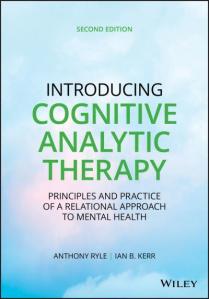
Book: Introducing Cognitive Analytic Therapy

Book Title:

Introducing Cognitive Analytic Therapy: Principles and Practice of a Relational Approach to Mental Health.

Author(s): Anthony Ryle and Ian B. Kerr.

Year: 2020.

Edition: Second (2nd).

Publisher: Wiley.

Type(s): Paperback and Kindle.

Synopsis:

Cognitive Analytic Therapy (CAT) is an increasingly popular approach to therapy that is now widely recognised as a genuinely integrative and fundamentally relational model of psychotherapy. This new edition of the definitive text to CAT offers a systematic and comprehensive introduction to its origins, development, and practice. It also provides a fully updated overview of developments in the theory, research, and applications of CAT, including clarification and re-statement of basic concepts, such as reciprocal roles and reciprocal role procedures, as well as extensions into new areas of expertise.

Introducing Cognitive Analytic Therapy: Principles and Practice of a Relational Approach to Mental Health, 2nd Edition starts with a brief account of the scope and focus of CAT and how it evolved and explains the main features of its practice. It next offers a brief account of a relatively straightforward therapy to give readers a sense of the unfolding structure and style of a time-limited CAT. Following that are chapters that consider the normal and abnormal development of the Self and that introduce influential concepts from Vygotskian, Bakhtinian and developmental psychology. Subsequent chapters describe selection and assessment; reformulation; the course of therapy; the ‘ideal model’ of therapist activity and its relation to the supervision of therapists; applications of CAT in various patient groups and settings and in treating personality type disorders; use in ‘reflective practice’; a CAT perspective on the ‘difficult’ patient; and systemic and ‘contextual’ approaches.

  • Presents an updated introduction and overview of the principles and practice of cognitive analytic therapy (CAT).
  • Updates the first edition with developments from the last decade, in which CAT theory has deepened and the approach has been applied to new patient groups and extended far beyond its roots.
  • Includes detailed, applicable ‘how to’ descriptions of CAT in practice.
  • Includes references to CAT published works and suggestions for further reading within each chapter.
  • Includes a glossary of terms and several appendices containing the CAT Psychotherapy File; a summary of CAT competences extracted from Roth and Pilling; the Personality Structure Questionnaire; and a description of repertory grid basics and their use in CAT.
  • Co-written by the creator of the CAT model, Anthony Ryle, in collaboration with leading CAT practitioner, trainer, and researcher, Ian B. Kerr.

Introducing Cognitive Analytic Therapy is the definitive book for CAT practitioners and CAT trainees at skills, practitioner, and psychotherapy levels. It should also be of considerable interest and relevance to mental health professionals of all orientations, including clinical psychologists, psychiatrists, counselors, mental health nurses, to those working in forensic and various institutional settings, and to a range of other health care and social work professionals.

Book: Cold War Freud

Book Title:

Cold War Freud – Psychoanalysis in an Age of Catastrophes.

Author(s): Dagmar Herzog.

Year: 2016.

Edition: First (1st).

Publisher: Cambridge University Press.

Type(s): Hardcover, Paperback, and Kindle.

Synopsis:

In Cold War Freud Dagmar Herzog uncovers the astonishing array of concepts of human selfhood which circulated across the globe in the aftermath of World War II.

Against the backdrop of Nazism and the Holocaust, the sexual revolution, feminism, gay rights, and anticolonial and antiwar activism, she charts the heated battles which raged over Freud’s legacy.

From the postwar US to Europe and Latin America, she reveals how competing theories of desire, anxiety, aggression, guilt, trauma and pleasure emerged and were then transformed to serve both conservative and subversive ends in a fundamental rethinking of the very nature of the human self and its motivations.

Her findings shed new light on psychoanalysis’ enduring contribution to the enigma of the relationship between nature and culture, and the ways in which social contexts enter into and shape the innermost recesses of individual psyches.

Book: Cognitive Behavioural Therapy for Depression

Book Title:

Cognitive Behavioral Therapy for Depression: Retrain your Brain from Wrong Behaviors, Irrational Beliefs and Negative Ways of Thinking. Open Yourself to Life, Happiness and the Freedom of Change.

Author(s): John Rich.

Year: 2019.

Edition: First (1st).

Publisher: Independently Published.

Type(s): Hardcover and Kindle.

Synopsis:

Depression is said to affect more than 300 million people globally, from all age categories. This particular mental disorder is incredibly common, and yet incredibly challenging for people to face, overcome, and heal from. Depression is considered to be a serious and even life-threatening condition as it can progress into more advanced stages that lead to thoughts surrounding self-harm and suicidal ideation.

Learning how to face, navigate, overcome, and heal from depression is important in your ability to protect yourself from the painful symptoms that depression can present in your life. If you have been looking for natural, healthy ways to overcome depression, cognitive behavioural therapy may be exactly what you are looking for.

Cognitive Behavioural Therapy (CBT) is a form of psychotherapy that is used to intentionally rewire the way your brain works through the power of specific thought processes and skills that are instilled within the individual that is healing from depression. As you learn how to navigate depression with CBT skills in tow, you will begin to realise how capable you are of overcoming this painful, dreadful, and often traumatising mental disorder that you might be facing in your life right now.

For some people, CBT is the only therapy that they need to support them in healing from depression. For others, CBT works in conjunction with lifestyle changes and even antidepressants to support a holistic form of therapy that helps the patient heal from depression in the immediate present while also being able to overcome episodes in the future.

The book seeks to shine a light on the power of CBT and how this particular psychotherapy can support you in having a healthier life, free of the struggles of depression. The goal is for you to learn to overcome depression in a way that supports you with increasing your mental strength, mental stamina, and emotional intelligence, while also improving your natural emotional resistance.

Some of what you will learn in Cognitive Behavioural Therapy for Depression includes:

  • What CBT is and how it works.
  • Who founded CBT and how.
  • What depression is and the specific symptoms to look for.
  • How you can use self-awareness to overcome depression.
  • How CBT works to heal depression.
  • How CBT supports mental and emotional strength and resiliency.
  • The exact steps for executing CBT in your own life.
  • How to monitor your CBT to make sure it is actually working.
  • How to use CBT to instantly boost your mood.
  • How to use CBT to boost your mood in the long term.
  • Natural methods for overcoming and healing depression.
  • And more!.

If you are ready to relieve yourself from the grasp of depression and heal yourself and your life, grab your copy of Cognitive Behavioural Therapy for Depression today to get started!