Posts

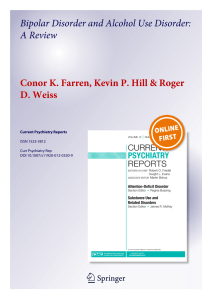
Research: Bipolar Disorder and Alcohol Use Disorder: A Review

Research Paper Title:

Bipolar Disorder and Alcohol Use Disorder: A Review.

Author(s): Conor Farren, Kevin P. Hall, and Roger D. Weiss.

Year: 2012.

Journal: Current Psychiatry Reports.

DOI: 10.1007/s11920-012-0320-9.

Abstract:

Bipolar disorder and alcohol use disorder represent a significant comorbid population, which is significantly worse than either diagnosis alone in presentation, duration, co-morbidity, cost, suicide rate, and poor response to treatment.

They share some common characteristics in relation to genetic background, neuroimaging findings, and some biochemical findings.

They can be treated with separate care, or ideally some form of integrated care.

There are a number of pharmacotherapy trials, and psychotherapy trials that can aid program development.

Post-treatment prognosis can be influenced by a number of factors including early abstinence, baseline low anxiety, engagement with an aftercare programme and female gender.

The future development of novel therapies relies upon increased psychiatric and medical awareness of the co-morbidity, and further research into novel therapies for the comorbid group.

You can download a copy of the full paper here.
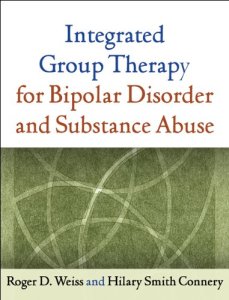
Book: Integrated Group Therapy for Bipolar Disorder and Substance Abuse

Book Title:

Integrated Group Therapy for Bipolar Disorder and Substance Abuse.

Author(s): Roger D. Weiss and Hilary S. Connery.

Year: 2011.

Edition: First (1st).

Publisher: Guildford Press.

Type(s): Paperback and Kindle.

Synopsis:

Packed with practical clinical tools, this book presents an empirically supported treatment expressly designed for clients with both bipolar disorder and substance use disorders. Integrated group therapy teaches essential recovery behaviours and relapse prevention skills that apply to both illnesses.

The volume provides a complete session-by-session overview of the approach, including clear guidelines for setting up and running groups, implementing the cognitive-behavioral treatment techniques, and troubleshooting frequently encountered problems.

In a large-size format for easy reference and photocopying, the book features more than 30 reproducible handouts, forms, and bulletin board materials.

Book: Internet Addiction in Children and Adolescents

Book Title:

Internet Addiction in Children and Adolescents: Risk Factors, Assessment, and Treatment.

Author(s): Kimberly S. Young and Cristiano Nabuco de Abreu (Editors).

Year: 2017.

Edition: First (1st).

Publisher: Springer Publishing Co Inc.

Type(s): Paperback and Kindle.

Synopsis:

This is the first book to thoroughly examine how early and easy access to the Internet and digital technologies impacts children and adolescents. Experts in the field examine the research that shows the social, cognitive, developmental, and academic problems that can result when children spend excessive time in front of screens. As a whole, the book provides an invaluable resource for those who need to assess, treat, and prevent Internet addiction in children and adolescents.

Internet Addiction in Children and Adolescents:

  • Provides tools that help predict a child’s level of risk for media-related problems.
  • Examines how to diagnose and differentiate Internet addiction from other psychiatric conditions.
  • Explores evidence-based treatment approaches and how to distinguish pathology from normal development.
  • Shows how to create inpatient treatment programs and therapies to address media addiction.
  • Highlights the psychological, social, and family conditions for those most at risk.
  • Evaluates the effects of the excessive use of electronic games and the Internet on brain development.
  • Explores the physical risks that result from excessive media use and strategies for combating the problem.
  • Examines school-based initiatives that employ policies and procedures designed to increase awareness of excessive media use and help educators identify students who misuse technology, and that provide strategies of intervention and communication with parents.
  • Identifies signs of problem Internet behavior such as aggressive behavior, lying about screen use, and a preference for screen time over social interactions.
  • Outlines the risk factors for developing Internet addiction.
  • Provides strategies for treatment and prevention in family, school, and community settings.

Practitioners and researchers in psychology, social work, school counseling, child and family therapy, and nursing will appreciate this book’s thorough review of Internet addiction among children and adolescents. The book also serves as an engaging supplement in courses on media psychology, addiction counseling, abnormal psychology, school counseling, social issues, and more.

Book: Internet Addiction

Book Title:

Internet Addiction: Prevalence, Risk Factors and Health Effects.

Author(s): Margaret Adams (Editor).

Year: 2016.

Edition: First (1st).

Publisher: Nova Science Publishers.

Type(s): Hardcover and Kindle.

Synopsis:

According to the World Health Organisation, pathological addiction is the psychic, and sometimes even physical, condition arising from the interaction between a living organism and an exogenous substance, characterised by behavioural responses and other reactions that always include a compulsive need to take the substance continuously or periodically, in order to get its psychic effects and/or to avoid the distress related to its withdrawal.

This book presents a review on Internet addiction, which is considered an emergent problem especially amongst adolescents, and examines the risk factors and health effects of this addiction.

Book: The International Encyclopedia of Depression

Book Title:

The International Encyclopedia of Depression.

Author(s): Richard E. Ingram, PhD (Editor).

Year: 2009.

Edition: First (1st).

Publisher: Springer Publishing Company, LLC..

Type(s): Hardcover and Kindle.

Synopsis:

There is no more central topic to mental health professionals than depression.

In the last 20 years, theory and research in depression has grown rapidly. The wealth of information now available on depression is enormous, but has not been summarized into a comprehensive encyclopedia until now.

The entries in this book include: behavioral treatment, cognitive theories, cognitive therapy, epidemiology, heredity, personality disorders, double depression, and prevention.

In summarising the vast amount of information on depression, The International Encyclopedia of Depression serves as an important resource for researchers, patients, students, and educated laypeople. This book presents holistic, interdisciplinary coverage of an important but misunderstood medical disorder.

You can find a copy of the book here.

On This Day … 07 October

People (Births)

  • 1927 – R. D. Laing, Scottish psychiatrist and author (d. 1989).

R.D. Laing

Ronald David Laing (07 October 1927 to 23 August 1989), usually cited as R.D. Laing, was a Scottish psychiatrist who wrote extensively on mental illness – in particular, the experience of psychosis.

Laing’s views on the causes and treatment of psychopathological phenomena were influenced by his study of existential philosophy and ran counter to the chemical and electroshock methods that had become psychiatric orthodoxy.

Taking the expressed feelings of the individual patient or client as valid descriptions of lived experience rather than simply as symptoms of mental illness, Laing regarded schizophrenia as a theory not a fact.

Though associated in the public mind with anti-psychiatry he rejected the label. Politically, he was regarded as a thinker of the New Left.

Laing was portrayed by David Tennant in the 2017 film Mad to Be Normal.

Schizophrenia: Lung Cancer & End-of-Life Care

Research Paper Title

Palliative and high-intensity end-of-life care in schizophrenia patients with lung cancer: results from a French national population-based study.

Background

Schizophrenia is marked by inequities in cancer treatment and associated with high smoking rates. Lung cancer patients with schizophrenia may thus be at risk of receiving poorer end-of-life care compared to those without mental disorder.

The objective was to compare end-of-life care delivered to patients with schizophrenia and lung cancer with patients without severe mental disorder.

Methods

This population-based cohort study included all patients aged 15 and older who died from their terminal lung cancer in hospital in France (2014-2016).

Schizophrenia patients and controls without severe mental disorder were selected and indicators of palliative care and high-intensity end-of-life care were compared.

Multivariable generalised log-linear models were performed, adjusted for sex, age, year of death, social deprivation, time between cancer diagnosis and death, metastases, comorbidity, smoking addiction and hospital category.

The analysis included 633 schizophrenia patients and 66,469 controls.

Results

The schizophrenia patients died 6 years earlier, had almost twice more frequently smoking addiction (38.1%), had more frequently chronic pulmonary disease (32.5%) and a shorter duration from cancer diagnosis to death.

In multivariate analysis, they were found to have more and earlier palliative care (adjusted Odds Ratio 1.27 [1.03;1.56]; p = 0.04), and less high-intensity end-of-life care (e.g., chemotherapy 0.53 [0.41;0.70]; p < 0.0001; surgery 0.73 [0.59;0.90]; p < 0.01) than controls.

Conclusions

Although the use and/or continuation of high-intensity end-of-life care is less important in schizophrenia patients with lung cancer, some findings suggest a loss of chance.

Future studies should explore the expectations of patients with schizophrenia and lung cancer to define the optimal end-of-life care.

Reference

Viprey, M., Pauly, V., Salas, S., Baumstrack, K., Orleans, V., Llorca, P-M., Lancon, C., Auquier, P., Boyer, L. & Fond, G. (2020) Palliative and high-intensity end-of-life care in schizophrenia patients with lung cancer: results from a French national population-based study. European Archives of Psychiatry and Clinical Neuroscience. doi: 10.1007/s00406-020-01186-z. Online ahead of print.

Book: Healing Depression without Medication

Book Title:

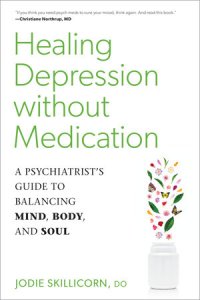
Healing Depression without Medication: A Psychiatrist’s Guide to Balancing Mind, Body, and Soul.

Author(s): Jodie Skillicorn, DO.

Year: 2020.

Edition: First (1st).

Publisher: North Atlantic Books.

Type(s): Paperback.

Synopsis:

What if everything we thought we knew about depression – and how to heal from it – was wrong?

Many antidepressants – the first line in our standard of care for treating depression – bring with them potential health risks, yet 1 in 6 Americans takes medication to alleviate feeling sad, anxious, stuck, or unable to focus or sleep. More and more, conventional medicine pathologises how we respond to life’s challenges – like feeling trapped in an unfulfilling job, grieving the death of a loved one, or being anxious about a bad relationship – telling us that they are symptoms of disease.

Psychiatrist Jodie Skillicorn presents a new path, debunking the myth of the neurochemical imbalance and exploring the roots of depression, such as adverse childhood experiences (ACEs) and poorly managed day-to-day stress. Evidence-based and fully supported by current depression research, Dr. Skillicorn’s holistic methods for beating depression – including nutrition, mindfulness, fostering meaningful connections, exercise, sleep, nature, and breathwork – empower readers to become agents of their own wholeness and healing.

Book: Good Morning, Monster

Book Title:

Good Morning, Monster – A Therapist Shares Five Heroic Stories of Emotional Recovery.

Author(s): Catherine Gildiner.

Year: 2020.

Edition: First (1st).

Publisher: St. Martin’s Press.

Type(s): Hardcover, Paperback, Audiobook, and Kindle.

Synopsis:

In this fascinating narrative, therapist Catherine Gildiner’s presents five of what she calls her most heroic and memorable patients. Among them: a successful, first generation Chinese immigrant musician suffering sexual dysfunction; a young woman whose father abandoned her at age nine with her younger siblings in an isolated cottage in the depth of winter; and a glamorous workaholic whose narcissistic, negligent mother greeted her each morning of her childhood with “Good morning, Monster.”

Each patient presents a mystery, one that will only be unpacked over years. They seek Gildiner’s help to overcome an immediate challenge in their lives, but discover that the source of their suffering has been long buried.

As in such recent classics as The Glass Castle and Educated, each patient embodies self-reflection, stoicism, perseverance, and forgiveness as they work unflinchingly to face the truth. Gildiner’s account of her journeys with them is moving, insightful, and sometimes very funny. Good Morning Monster offers an almost novelistic, behind-the-scenes look into the therapist’s office, illustrating how the process can heal even the most unimaginable wounds.

Book: Family Therapy and The Autism Spectrum

Book Title:

Family Therapy and The Autism Spectrum – Autism Conversations In Narrative Practice.

Author(s): Marilyn J. Montero.

Year: 2016.

Edition: First (1st).

Publisher: Routledge.

Type(s): Hardcover, Paperback, and Kindle.

Synopsis:

The autism spectrum presents a range of communication, social, and sensory differences that are challenging for clinicians to address. Family Therapy and the Autism Spectrum provides a guide to conceptualising those differences and ways to discuss them with clients and their families. Readers are provided with narrative examples illustrating the application of key concepts introduced in the text. These case examples address issues that range across the life cycle, from families with young children to ones with teens who are emerging as adults. Using the techniques learned in this book, clinicians will be able to guide families towards their positive autism narrative.

This book also features a visual framework to organise the compelling narrative of each person’s autism spectrum pattern of developmental differences or brain style. Using this visual framework and the corresponding descriptive language, clinicians and families can work together to create their “autism conversations.” The conversations lead to the transformative experiences of developing competencies, resiliency, and advocacy for individuals and their families. The conversations also lead individuals with spectrum differences to use empowering language, supporting their ability to develop self-advocacy and self-determination skills.