Posts

Book: The Economics Of Addictive Behaviours – Volume III

Book Title:

The Economics Of Addictive Behaviours – Volume III: The Private and Social Costs of the Abuse of Illicit Drugs and Their Remedies.

Author(s): John Joshua.

Year: 2017.

Edition: First (1ed).

Publisher: Palgrave Macmillan.

Type(s): Hardcover, Paperback, and Kindle.

Synopsis:

This title offers an in-depth analysis of the causes, consequences and treatments of illicit drug abuse. The author examines the effects of existing drug policies and proposes drug use legalisation within a regulated market as a viable alternative. Joshua assesses the factors that make individuals vulnerable to drug abuse and the pathways they may follow. As well as exploring the physical and psychological effects on the individual, Joshua examines the social and economic consequences for society. He highlights the pitfalls of a purely legal approach to drug abuse, which is primarily a health matter, and questions whether special drugs courts could be used as an alternative to the present criminal justice system. This book adds to the debate on whether most drugs could be sold in a regulated market in the same way as other drugs are, such as alcohol or nicotine.

This is the third title in a four volume series ‘The Economics of Addictive Behaviours’, consisting of three additional volumes on smoking, alcohol abuse and overeating.

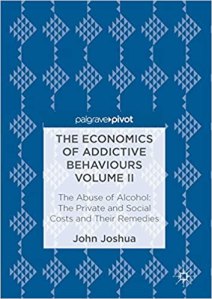
Book: The Economics Of Addictive Behaviours – Volume II

Book Title:

The Economics Of Addictive Behaviours – Volume II: The Private and Social Costs of Alcohol and Their Remedies.

Author(s): John Joshua.

Year: 2017.

Edition: First (1ed).

Publisher: Palgrave Macmillan.

Type(s): Hardcover, Paperback, and Kindle.

Synopsis:

This title discusses the phenomenon of alcohol abuse as a behavioural disease and the associated costs. The author details alcohol’s status as a psychoactive drug; he notes, however, that in contrast to other psychoactive drugs, alcohol has been widely culturally accepted in Western countries and legally available, except in isolated incidents for a short period of time. Joshua considers which policies are being correctly utilised so as to reduce the abuse of alcohol, and how these policies may operate on a supply and demand model. Whereas programs of prevention and treatment operate on the demand side of alcohol abuse, legislation is directed at the supply side of alcohol; that is, dealing with marketing – product, promotion, point of sales and price.

This is the second title in a four volume series ‘The Economics of Addictive Behaviours’, consisting of three additional volumes on smoking, illicit drug abuse and overeating.

Book: The Economics Of Addictive Behaviours – Volume I

Book Title:

The Economics Of Addictive Behaviours – Volume I: The Private and Social Costs of Smoking and Their Remedies.

Author(s): John Joshua.

Year: 2017.

Edition: First (1ed).

Publisher: Palgrave Macmillan.

Type(s): Hardcover, Paperback, and Kindle.

Synopsis:

This title discusses the phenomenon of smoking as a behavioural disease and the associated costs. The author details the consequences of smoking, in addition to the detrimental effects caused by second-hand tobacco smoke exposure as a health risk to children as well as to the general public. The central contribution of Joshua’s work is to address these concerns in terms of the issues of free choice and the market. Considering the various restrictive policies designed to reduce smoking’s prevalence, including the banning of smoking in public places, and the inclusion of warning labels on cigarette packets, Joshua carefully analyses potential economic remedies to the problem of smoking, notably the Pigovian tax. Finally, the book concludes with a highly relevant discussion of corporate social responsibility, and the role that this might play in anti-smoking projects.

This is the first title in a four volume series ‘The Economics of Addictive Behaviours’, which consists of three further volumes on alcohol abuse, illicit drug abuse and overeating.

Do Older Adults with Parent(s) Alive Experience Higher Psychological Pain and Suicidal Ideation?

Research Paper Title

Do Older Adults with Parent(s) Alive Experience Higher Psychological Pain and Suicidal Ideation? A Cross-Sectional Study in China.

Background

Elderly mental health promotion is an important task in the current “Healthy China Action”.

This study aims to:

  1. Clarify the psychological pain and suicidal ideation of the Chinese elderly with different parental states;
  2. Examine the associated factors of psychological pain and suicidal ideation; and
  3. Examine the relationship between psychological pain and suicidal ideation.

Methods

A sample of 4622 adults aged 60 years and older were included in this study, from the China’s Health-related Quality of Life Survey for Older Adults 2018.

Results

Participants with both parents alive demonstrated the heaviest psychological pain, and those with one parent alive observed significantly lowest psychological pain and suicidal ideation.

Participants who were single, divorced, or widowed, live in rural areas, had higher education level, had lower family income, suffered from two or more chronic diseases, and had no self-care ability were more likely to experience psychological pain and suicidal ideation.

In addition, higher psychological pain was significantly associated with the occurrence of suicidal ideation.

Conclusions

In China, much more attention should be paid to the mental health condition of the elderly, especially for those with both parents alive.

Moreover, the associated factors above should be considered to develop targeted health interventions.

Reference

Yang, Y., Wang, S., Hu, B., HAo, J., Hu, R., Zhou, Y. & Mao, Zongfu. (2020) Do Older Adults with Parent(s) Alive Experience Higher Psychological Pain and Suicidal Ideation? A Cross-Sectional Study in China. International Journal of Environmental Research and Public Health. 17(17), pp.E6399. doi: 10.3390/ijerph17176399.

Book: Eating Disorders – What Everyone Needs to Know

Book Title:

Eating Disorders – What Everyone Needs to Know.

Author(s): B. Timothy Walsh, Evelyn Attia, and Deborah R. Glasofer.

Year: 2020.

Edition: First (1ed).

Publisher: OUP USA.

Type(s): Hardcover, Paperback, and Kindle.

Synopsis:

Eating disorders are potentially life-threatening psychiatric illnesses commonly accompanied by serious medical problems. They typically appear during adolescence or early adulthood, a time when young people are heading to college or interviewing for a first job. Many people recover fully from eating disorders, but others become chronically ill, and symptoms can continue into middle age and beyond.

Written by leading authorities in eating disorders research and treatment, Eating Disorders: What Everyone Needs to Know answers common questions about eating disorders, including anorexia nervosa, bulimia nervosa, and binge eating disorder, as well as a newly described condition, avoidant/restrictive food intake disorder (ARFID). Practical yet authoritative, the book defines the eating disorders, explains what we know about them based on the latest science, and describes how treatment works. Importantly, the book dispels common myths about eating disorders, such as the notion that they occur only amongst the affluent, that they affect only girls and women, or that they simply result from environmental factors such as the fashion industry and society’s obsession with thinness. In reality, as the book explains, there is substantial evidence that eating disorders are brain-based illnesses that do not discriminate, and that they have been around for a very long time. Eating Disorders: What Everyone Needs to Know is essential reading for those seeking authoritative and current information about these often misunderstood illnesses.

Book: Doing Psychotherapy – A Trauma And Attachment-Informed Approach

Book Title:

Doing Psychotherapy – A Trauma And Attachment-Informed Approach.

Author(s): Robin Shapiro.

Year: 2020.

Edition: First (1st).

Publisher: W.W. Norton & Company.

Type(s): Paperback, Kindle, and Audiobook.

Synopsis:

Most books about doing psychotherapy are tied to particular psychotherapeutic practices. Here, seasoned clinical author Robin Shapiro teaches readers the ins and outs of a trauma-and attachment-informed approach that is not tied to any one model or method.

This book teaches assessment, treatment plans, enhancing the therapeutic relationship and ethics and boundary issues, all within a general framework of attachment theory and trauma. Practical chapters talk about working with attachment problems, grief, depression, cultural differences, affect tolerance, anxiety, addiction, trauma, skill- building, suicidal ideation, psychosis, and the beginning and end of therapy.

Filled with examples, suggestions for dialogue and questions for a variety of therapeutic situation, Shapiro’s conversational tone makes the book very relatable. Early-career therapists will refer to it for years to come and veteran practitioners looking for a refresher (or introduction) to the latest in trauma and attachment work will find it especially useful.

Book: Conquer Worry and Anxiety – The Secret to Mastering Your Mind

Book Title:

Conquer Worry and Anxiety – The Secret to Mastering Your Mind.

Author(s): Daniel G. Amen, MD.

Year: 2020.

Edition: First (1st).

Publisher: Tyndale Momentum.

Type(s): Paperback and Kindle.

Synopsis:

You can overcome worry and anxiety today. It is possible to feel better fast – and to make it last.

Many people, mental health professionals included, think therapy needs to be long, hard, and painful – a lifelong commitment. And while some people will need help longer than others, it is often possible for people to start feeling better right now. If you engage in the right behaviours and strategies, you’ll optimize your brain health – and see the benefits in your everyday life.

In Conquer Worry and Anxiety, renowned psychiatrist Dr. Daniel G. Amen will guide you to lasting change, teaching you how to make decisions that serve your brain’s health and set you on a path to a happier, healthier life. Each of us can make small changes that, over time, create amazing results.

Book: Community Psychology – Linking Individuals and Communities

Book Title:

Community Psychology – Linking Individuals and Communities.

Author(s): James Dalton, Maurice Elias, and Abraham Wandersman.

Year: 2011.

Edition: Third (3rd).

Publisher: Cengage Learning Custon Publishing.

Type(s): Hardcover and Paperback.

Synopsis:

Learn through application with community psychology! Featuring concrete examples and numerous study tools, this psychology text helps you understand the concepts and then provides opportunities for you to apply them. Brief outlines of chapter content, anticipatory questions, key points, brief exercises, summaries, and self tests are just a few of the tools that will help you succeed in this course. Programs and citizen initiatives for enriching the quality of individual and community life – such as Alcoholics Anonymous and the San Francisco Depression Prevention Project – show you what community psychology means in the real world. At the end of each chapter, you will find website references to model or recommended projects that connect you to community resources.

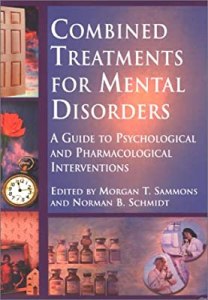
Book: Combined Treatments for Mental Disorders

Book Title:

Combined Treatments for Mental Disorders: A Guide to Psychological and Pharmacological Interventions.

Author(s): Morgan T. Sammons and Norman B. Schmidt (editors).

Year: 2001.

Edition: First (1st).

Publisher: American Psychological Association.

Type(s): Hardcover.

Synopsis:

An exploration of the best way to integrate pharmaceuticals and pyschotherapy in the treatment of mental disorders. Combined treatment is relatively common, but because of biases in the fields of medicine and psychology that champion one form over another, many clinicians are not fully informed about use of both modalities. This practical volume seeks to end this situation.

As this text reveals, exclusive reliance on one mode of treatment may result in a practitioner being unable to address many clients’ needs. Each chapter closely examines the combined treatment for a different disorder, such as insomnia, depression, schizophrenia, and obsessive-compulsive disorder. Different disorders are addressed in separate chapters in relation to combined treatments which many clinicians may not be fully informed of. The social and ethical ramifications of prescriptive authority for pyschologists is also addressed in relation to its increasing relevance. A practical guide for clinicians both experienced and non-experienced in the psychological and pharmacological fields.

Alzheimer’s Disease: Carers and their Mental Health

Research Paper Title

Predictors of mental health problems in formal and informal caregivers of patients with Alzheimer’s disease.

Background

Caring for a person with Alzheimer’s disease (AD) is associated with significant mental burden e.g., depression and anxiety, and difficulties with social, familial, and professional functioning. To date, few studies have examined variables which would allow for a comprehensive and detailed study of the relationship between personal resources and caregiver health status, with a majority of studies focusing on factors that contribute to increased caregiver’s burden. Moreover, the available evidence fails to address differences in the functioning of formal and informal carers. Paying proper attention to the problems of nursing home staff can help identify important risk factors. Therefore, this study compared mental health problems in informal and formal caregivers and examined the relationship between mental resources and mental health problems in both groups of caregivers.

Methods

This cross-sectional study examined 100 formal (n = 50) and informal (n = 50) caregivers of AD patients. Personal resources were measured with the Social Support Questionnaire (SSQ), the Generalised Self-Efficacy Scale (GSES), and the Sense of Coherence Questionnaire (SCQ), while mental health was assessed with the Depression Assessment Questionnaire (DAQ) and the General Health Questionnaire (GHQ). Multivariate stepwise regression was performed separately for both investigated groups.

Results

There were no significant differences between informal and formal caregivers in terms of psychological variables, i.e., sense of coherence, social support, self-efficacy, or mental health problems. In contrast, there were different significant predictors of mental health problems in both groups. Comprehensibility (SCQ) was a significant predictor of mental health problems measured by DAQ and self-efficacy (GSES) was a significant predictor of mental health problems measured by GHQ in informal caregivers. For formal caregivers, emotional support (SSQ) and comprehensibility (SCQ) were significant predictors of mental health problems measured by DAQ, while tangible support (SSQ) and meaningfulness (SCQ) were significant predictors of mental health problems measured by GHQ.

Conclusions

Personal resources are significant predictors of mental health outcomes in caregivers of AD patients. Preventive actions should therefore include assessment of factors affecting caregivers’ mental health in order to provide them with necessary care and create appropriate support groups.

Reference

Soltys, A. & Tyburski, E. (2020) Predictors of mental health problems in formal and informal caregivers of patients with Alzheimer’s disease. BMC Psychiatry. 20(1), pp.435. doi: 10.1186/s12888-020-02822-7.