Book: Brian Changer: How Diet can Save your Mental Health

Book Title: Brain Changer: How diet can save your mental health – cutting-edge science from an expert.

Author(s): Professor Felice Jacka.

Year: 2019.

Edition: First.

Publisher: Yellow Kite.

Synopsis:

A combination of Professor Felice Jacka’s love of food and her own experience of depression and anxiety as a young woman led her to question whether what we put in our mouths everyday affects more than our waistline. Felice set out on a journey of discovery to change the status quo and uncover the truth through rigorous science. Beginning her PhD in 2005, she examined the association between women’s diets and their mental health, focusing on depression and anxiety. She soon discovered – you feel how you eat. It is Professor Jacka’s ground-breaking research that has now changed the way we think about mental and brain health in relation to diet.

Brain Changer explains how and why we should consider our food as the basis of our mental and brain health throughout our lives. It includes a selection of recipes and meal plans featuring ingredients beneficial to mental health. It also includes the simple, practical solutions we can use to help prevent mental health problems in the first place and offers strategies for treating these problems if they do arise.

This is not a diet book to help you on the weight scales. This is a guide to good habits to save your brain and to optimise your mental health through what you eat at every stage of life.

Book: Ayurveda 101

Book Title: Ayurveda 101: Ayurveda Basics for The Absolute Beginner [Achieve Natural Health and Well Being through Ayurveda].

Author(s): Advait.

Year: 2016.

Edition: First.

Publisher: CreateSpace Independent Publishing Platform.

Synopsis:

The Ultimate Beginner’s Guide to Ayurveda Have you been searching for proven natural remedies for Achieving Everlasting Health Holistically???

Has your search lead you to Ayurveda??? But, you don’t know where to start and are waiting to be initiated into the Amazing world of Ayurvedic Healing….Then this book is for you.

Discover :: Ayurveda 101 – Ayurveda Basics for The Absolute Beginner This Book will teach you everything you need to know about Ayurveda as a Beginner.

Here’s a sneak peak at the contents of the book; #Origin of Ayurveda #Ashtaanga Veda – The Eight branches of Ayurveda #Panch Maha Bhuta’s – The Five Fundamental Elements #The Three Dosha’s and Your Prakriti – Vata – Pitta – Kapha #The Tri-Dosha test for determining your Prakriti #Sapta-Dhatu – The Seven Body Tissues #Jathar-Agni – The Digestive Fire #Trayodasha Vega – The 13 Natural Urge’s.

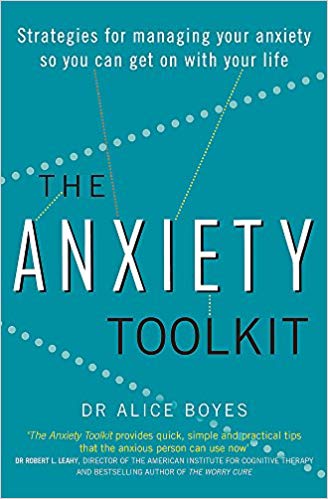
Book: The Anxiety Toolkit

Book Title: The Anxiety Toolkit: Strategies for Managing your Anxiety so you can Get on with Your Life.

Author(s): Dr. Alice Boyes.

Year: 2015.

Edition: First.

Publisher: Piatkus.

Synopsis:

Do you overthink before taking action? Are you prone to making negative predictions? Do you worry about the worst that could happen? Do you take negative feedback very hard? Are you self-critical? Does anything less than perfect performance feel like failure?

If any of these issues resonate with you, you’re probably suffering from some degree of anxiety, and you are not alone. The good news: while reducing your anxiety level to zero is not possible or useful (anxiety can actually be helpful!), you can learn to successfully manage symptoms – such as excessive rumination, hesitation, fear of criticism and paralysing perfection.

In The Anxiety Toolkit, Dr Alice Boyes translates powerful, evidence-based tools used in therapy clinics into tips and tricks you can employ in everyday life. Whether you have an anxiety disorder, or are just anxiety-prone by nature, you will discover how anxiety works, strategies to help you cope with common anxiety ‘stuck’ points and a confidence that – anxious or not – you have all the tools you need to succeed in life and work.

Book: The Anxiety Solution

Book Title: The Anxiety Solution: A Quieter Mind, A Calmer You.

Author(s): Chloe Bortheridge.

Year: 2017.

Edition: First.

Publisher: Michael Joseph.

Synopsis:

This is a book for anyone experiencing anxiety – at home, in school or at work, in social situations or on their own – one that will benefit everyone from worried mums to stressed teens.

The Anxiety Solution is a simple and inspiring guide to reducing anxiety from former sufferer and qualified clinical hypnotherapist, and host of The Calmer You podcast, Chloe Brotheridge.

Chloe will help you understand why we feel anxious and will equip you with techniques to help manage the symptoms and start living a happier, more confident life. Based on the latest scientific research and her unique programme which has already helped hundreds of clients, The Anxiety Solution will show you how to regain control of your life.

‘I know what it’s like to be stuck in a cycle of anxiety. I used to feel as though fear and worry were a permanent part of who I was . . . but I’m here to tell you that it doesn’t have to be this way. The truth is, your natural state is one of calmness and confidence – and I’m going to teach you how to get there.’

If you want to spend less time worrying, this book is the solution for you. You’ll be surprised how quickly you can be back in control and able to enjoy your life once again.

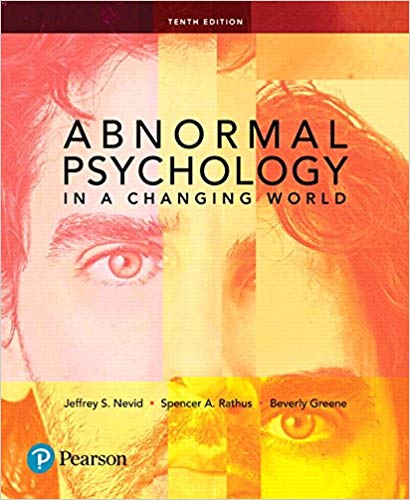
Book: Abnormal Psychology in a Changing World

Book Title: Abnormal Psychology in a Changing World.

Author(s): Jeffery S. Nevid, Spencer A. Rathus, and Beverly Greene.

Year: 2018.

Edition: Tenth.

Publisher: Pearson Education.

Synopsis:

Abnormal Psychology in a Changing World makes complex abnormal psychology concepts accessible and stimulating to students.

Authors Jeffrey Nevid, Spencer Rathus, and Beverly Greene present illustrative case examples drawn from their own clinical and teaching experiences, leading students to recognise the human dimension of the study of abnormal psychology.

Updated to reflect the latest advancements in the field, the Tenth Edition highlights the ways in which personal technology is changing the study of abnormal psychology via the new Abnormal Psychology in the Digital Age feature.

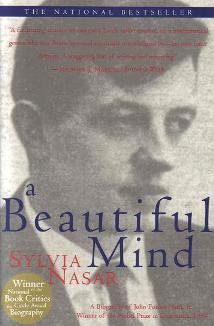
Book: A Beautiful Mind

Book Title: A Beautiful Mind.

Original Title: A Beautiful Mind: a Biography of John Forbes Nash, Jr., Winner of the Nobel Prize in Economics, 1994.

Author: Sylvia Nasar.

Year: 1998.

Publisher: Simon & Schuster.

Synopsis:

A Beautiful Mind (1998) is a biography of Nobel Prize-winning economist and mathematician John Forbes Nash, Jr. by Sylvia Nasar, professor of journalism at Columbia University.

An unauthorised work, it won the National Book Critics Circle Award in 1998 and was nominated for the Pulitzer Prize in biography.

It inspired the 2001 film by the same name.

Starting with his childhood, the book covers Nash’s years at Princeton and MIT, his work for the RAND Corporation, his family and his struggle with schizophrenia.

Although Nasar notes that Nash did not consider himself a homosexual, she describes his arrest for indecent exposure and firing from RAND amid the suspicion that he was, then considered grounds for revoking one’s security clearance.

The book ends with Nash being awarded the Nobel Prize in Economics in 1994.

The book is a detailed description of many aspects of Nash’s life, including the nature of his mathematical genius, and a close examination of his personality and motivations.

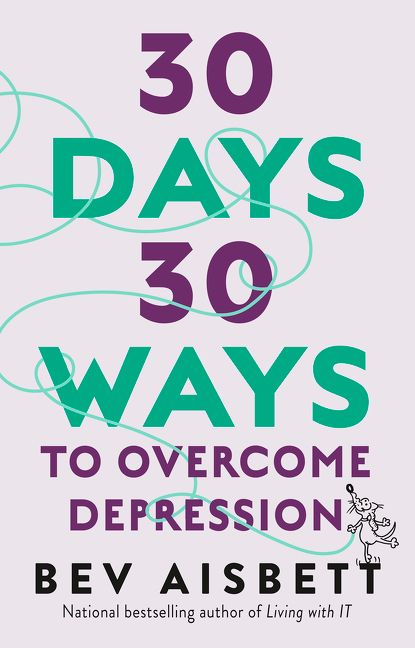
Book: 30 Days 30 Ways To Overcome Depression

Book Title: 30 Days 30 Ways to Overcome Depression

Author: Bev Aisbett.

Year: 2019.

Publisher: HarperCollins, London, UK.

Synopsis:

From bestselling author Bev Aisbett comes a proven, practical and simple workbook to help people manage their depression, with a month’s worth of daily strategies and exercises for work and for home.

When you’re suffering from depression, sometimes it’s as much as you can do to get out of bed, let alone read a book. But this just isn’t any other book. This is a practical day-by-day workbook, with clear, simple daily building blocks and exercises designed to help pull you out of the inertia of depression. It’s a highly approachable, concise and above all practical way to help manage depression.

Featuring all-new material from experienced counsellor and bestselling author of the self-help classics Living with IT and Taming the Black Dog, Bev Aisbett has based this book on many of the exercises she has been teaching and writing about for the past twenty years to help people manage their depression.

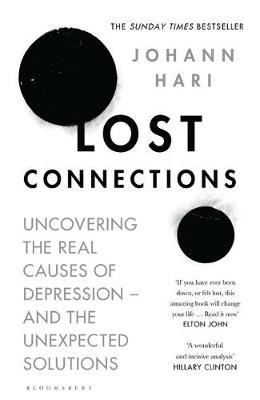
Book: Lost Connections

Book Title: Lost Connections: Uncovering the Real Causes of Depression – and the Unexpected Solutions.

Author: Johann Hari.

Year: 2018.

Publisher: Bloomsbury Circus, 50 Bedford Square, London, UK.

Synopsis:

A radically new way of thinking about mental health. What really causes depression and anxiety – and how can we really solve them? Award-winning journalist Johann Hari suffered from depression since he was a child and started taking anti-depressants when he was a teenager. He was told that his problems were caused by a chemical imbalance in his brain. As an adult, trained in the social sciences, he began to investigate whether this was true – and he learned that almost everything we have been told about depression and anxiety is wrong.

Across the world, Hari found social scientists who were uncovering evidence that depression and anxiety are largely caused by key problems with the way we live today. Hari’s journey took him from a mind-blowing series of experiments in Baltimore, to an Amish community in Indiana, to an uprising in Berlin. Once he had uncovered nine real causes of depression and anxiety, they led him to scientists who are discovering seven very different solutions – ones that work.

Did you know that Mental Health Sites Share User Data with Ad Firms?

Mental health websites are sharing user data with advertisers, including the results of tests for depression.

This means that individuals seeking information or help for mental health conditions can be targeted with adverts while they may be vulnerable.

Researchers, from Privacy International based in London, looked at 136 of the most popular websites in the UK, France and Germany that provide resources and information about mental health conditions.

The researchers found that 76% of the websites contained third party marketing trackers. These collect information about a user and can track them as they browse other sites.

This can be combined into a detailed profile.

Many of the pages had trackers from Google, Facebook and Amazon and shared information with data brokers – firms that aggregate information and sell individual profiles to other organisations – and advertising companies.

Commentators state that it is currently (almost) impossible to seek information and help about depression without advertisers knowing.

Knowing who is depressed and when allows advertisers to target people when they are at their most vulnerable.

Advertisers target users based on their personal data, such as their IP address and location, and the site they visit. Some sites also have real-time bidding, where information, including a page’s content and URL, is used to instantaneously show a relevant ad on the page.

Several websites with questionnaires about depression stored users’ answers and shared them with third parties.

When the researchers first analysed the UK’s National Health Service (NHS) website in September 2019, they found that a mood self-assessment quiz shared individual answers, test scores and the test URL with Adobe for analysis purposes. However, the NHS website has since updated its privacy policy so users now need to manually opt in to be tracked.

The researchers also found that doctissimo.fr, one of France’s most popular health websites, sent unique user identifiers and answers to a data collection firm. They basically send all of an individuals answers to the test to a third party that is named nowhere on their website, and nowhere in their privacy policy. A perfect example of abusing someone’s confidence.”

Under the European Union’s General Data Protection Regulation (GDPR), websites and apps are required to obtain consent before tracking users.

Data relating to physical or mental health is considered a “special category” and can only be processed with explicit consent or for relevant other reasons.

Reference

Lu, D. (2019) Mental Health Sites Share User Data with Ad Firms. New Scientist. 07 December 2019, pp.9.

Suicide in Older Adults: A Critical Problem

Research Paper Title

Suicide in Older Adults.

Abstract

Suicide in older adults is a critical problem that nurses and other health professionals need to address. Evidence-based interventions for prevention of late-life suicide are urgently needed, as well as increased availability of health care professionals with knowledge and skills to recognise suicide risks and intervene to provide effective care for this vulnerable population.

Reference

Sorrell, J.M. (2020) Suicide in Older Adults. Journal of Psychosocial Nursing and Mental Health Services. 58(1), pp.17-20. doi: 10.3928/02793695-20191218-04.