In North America, over 25 million parents are being erased from their children’s lives after divorce and separation.
The Erasing Family documentary follows young adults fighting to reunite with their broken families.
Outline
This documentary exposes the failure of family courts to keep children from being used as a weapon after separation. Courts decision ends up completely erasing one parent causing severe emotional trauma to children.
Psychologist refer to extreme cases as parental alienation which is a form of Child Psychological Abuse.
Essentially brainwashing and manipulating children by one parent to hate or despise the other parent.
This results in severe psychological damage based on scientific findings, including depression, low self esteem, drug abuse, and being alienated from own children and suicide.
Family court reform is badly needed as this is preventable pandemic affecting over 20 million children in the United States.
Happy endings are possible! The film ends with children and parents being reunited on screen and will inspire other kids to reach out to #erased parents, siblings and grandparents.
The film will show how programmes that encourage mediation and shared parenting which will prevent future childhood trauma, making divorce and separation less costly both financially and emotionally.
Help
For those in the US, text HELP to (865)-4FAMILY between 8am-10pm ET to get emotional support if you are an erased kid or parent (not legal advice).
A husband is suffering from melancholia, and he wants to commit suicide. His wife, who is a cartoonist, forces him to quit his job for the therapy. The wife’s optimism influence the husband, and they live happily ever after.
Also known as Tsure ga utsu ni narimashite (original title), 丈夫得了抑郁症 (China, Mandarin, festival title), and ツレがうつになりまして。(Japanese).
Outline
Mikio (Masato Sakai) is a married man and works hard for the company where he is employed. Then one day Mikio is diagnosed with depression. Mikio’s wife is Haruko (Aoi Miyazaki). They have been married for 5 years. Haruko draws comics for work, but they do not sell well. She mainly relied on Mikio for support. Meanwhile, Haruko did not notice any changes in her husband. She begins to blame herself for not noticing any signs. Mikio’s depression derived from his work. His company has been pressing him to quit the company. After Mikio quits his job his condition improves, but the dynamics of their relationship changes.
Cast
Mitsuru Fukikoshi – Sugiura.
Kanji Tsuda – Kazuo Takazaki.
Hiroshi Inuzuka – Kawaji.
Tomio Umezawa – Takashi Mikami.
Ryosei Tayama – Kamo.
Ren Osugi – Yasuo Kurita (Haruko’s dad).
Kimiko Yo – Satoko Kurita (Haruko’s mom).
Hiroshi Yamamoto – Kimizuka.
Saburo Tamura – Tsuda.
Yuta Nakano – Obata.
Atsushi Mizutani.
Awards
2011 (36th) Hochi Film Awards – 29 November 2011 – Best Actor (Masato Sakai).
Trivia
Based on the manga “Tsure ga Utsu ni Narimashite” by female manga artist Tenten Hosokawa.
The manga also inspired the NHK 2009 drama “How Do I Cope with My Husband’s Depression?” (Tsure ga utsu ni narimashite, NHK, 2009).
Movie director Kiyoshi Sasabe planned directing the film for 4 years.
Filming began January 9th and is expected to finish early February.
Aoi Miyazaki & Masato Sakai previously worked together in the 2008 taiga drama “Atsuhime”.
A raw and revealing documentary chronicling the prolific combat-sports broadcaster Mauro Ranallo and his lifelong battle with mental illness.
Outline
Mauro Ranallo has called some of the biggest combat sports events in history – all while fighting his own mental health battle. Follow his journey in this unflinching account of his struggle to confront the stigma of Bipolar Disorder.
Production & Filming Details
Director(s): Haris Usanovic.
Producer(s):
Ashley Ayaz … line producer.
Brian Dailey … producer.
Stephen Espinoza … executive producer.
Dan Fried … executive producer.
Louis Krubich … executive producer.
Haris Usanovic … producer.
Writer(s): Mitchell Hooper and Haris Usanovic.
Music:
Cinematography: Mark Cambria, Mitchell Hooper, and Haris Usanovic.
Veterans struggling with PTSD are paired with service dogs as they undergo rehabilitation.
Outline
Man’s best friend is living up to its moniker in this docuseries. It presents stories of shelter dogs trained to help veterans suffering from post-traumatic stress disorder re-acclimate to civilian life.
Each hourlong episode chronicles the rigorous process involved with pairing a vet with a service dog, an emotional journey whereby a suffering person and an abandoned dog come together to help each other.
Facilitating the unions is Paws and Stripes, the brainchild of Lindsey Stanek. Her husband, Jim – a retired US Army staff sergeant who served three tours in Iraq – suffered from severe PTSD before visits with a service dog helped him relax.
Inspired by his experience, and motivated by her love of dogs and country, Lindsey created the non-profit organisation that allows veterans to participate at no cost.
The widespread mental health issues among Olympic athletes are examined in this documentary.
Outline
The Weight of Gold is an HBO Sports documentary exploring the mental health challenges that Olympic athletes often face.
The film comes during a time when the COVID-19 pandemic has postponed the 2020 Tokyo Games – the first such postponement in Olympic history – and greatly exacerbated mental health issues.
The film seeks to inspire discussion about mental health issues, encourage people to seek help, and highlight the need for readily available support.
It features accounts from Olympic athletes who share their own struggles with mental health issues, including Michael Phelps, Apolo Ohno, Shaun White, Lolo Jones, Gracie Gold, Katie Uhlaender, Bode Miller, David Boudia, Jeremy Bloom, Sasha Cohen, and, posthumously, Steven Holcomb and Jeret “Speedy” Peterson (via his mother, Linda Peterson).
Production & Filming Details
Director(s): Brett Rapkin.
Producer(s):
Jeremy Bloom … executive producer.
Peter Carlisle … executive producer.
Michael O. Lynch … executive producer.
Scott Martin … producer.
Peter Nelson … executive producer.
Michael Phelps … executive producer.
Brett Rapkin … executive producer.
Jack Sheehan … producer.
Michael Thomas Slifkin … producer.
Amber Theoharis … executive producer.
Ellyn Vander Wyden … producer.
Bentley Weiner … executive producer.
Writer(s): Aaron Cohen and Brett Rapkin.
Music: Simon Taufique.
Cinematography: Steven Dieveney, Dan Marks, James Pilott, and John Rasmussen.
The authors propose a new approach to the definition of mental health, different than the definition proposed by the World Health Organisation, which is established around issues of person’s well-being and productivity.
It is supposed to reflect the complexity of human life experience.
Introduction
The definition of mental health proposed by the World Health Organization (WHO) is organised around a hedonic and eudaimonic perspective, in which a key role is assigned to person’s well-being and productivity. While regarding well-being as a desirable goal for many people, its inclusion in the definition of mental health raises concerns. According to Keyes, well-being includes emotional, psychological and social well-being, and involves positive feelings (e.g., happiness, satisfaction), positive attitudes towards own responsibilities and towards others, and positive functioning (e.g., social integration, actualisation and coherence).
However, people in good mental health experience a wide range of emotions, such as sadness, anger or unhappiness; most adolescents are often unsatisfied, unhappy about present social organisation and may lack social coherence. Does this mean that they are not in good mental health? A person responsible for her/his family might feel desperate after being fired from his/her job, especially in a situation characterised by scarce occupational opportunities; should we question her/his mental health? Actually, raising the bar of mental health may create unrealistic expectations, encourage people to mask most of their emotions while pretending constant happiness, and even favour their isolation when they feel sad, angry or worried.
Also the concept of positive functioning (“can work productively and fruitfully”), in line with the eudaimonic tradition, raises concerns, as it implies that a person at an age or in a physical or even political condition preventing her/him from working productively is not by definition in good mental health.
The definition of mental health is clearly influenced by the culture that defines it. However, as also advocated by Vaillant, an effort can be made to identify elements that have a universal importance for mental health, as for example, vitamins and the four basic food groups are universally given a key role in eating habits, in spite of cultural differences.
Galderisi, S., Heinz, A., Kastrup, M., Beezhold, J. & Sartorius, N. (2020) A proposed new definition of mental health. Psychiatria Polska. 51(3), pp.407-411. doi: 10.12740/PP/74145. Epub 2017 Jun 18.
Midland’s businessman Paul Downes hires a castle in Jamaica and invites 12 young Ukrainian women to join him in the hope one will marry him. Paul suffers bi-polar disorder and has a manic episode – his plans turn bizarre and troubling.
Outline
Midland’s businessman Paul Downes hires a castle in Jamaica and invites 12 young Ukrainian women to join him in the hope one will marry him. Unfortunately Paul suffers bi-polar disorder and has a manic episode for most of the two week holiday. He quickly loses interest in the women and what at first looked like a distorted reality TV show transforms into a bizarre spin on James Bond as Paul plots to take over the world.
Production & Filming Details
Director(s): Mark James.
Producer(s): martin Herring and Mike Lerner.
Writer(s):
Music: Amlak Tafari.
Cinematography: Mark James.
Editor(s): Mark James.
Production: Roast Beef Productions and Widestream Films.
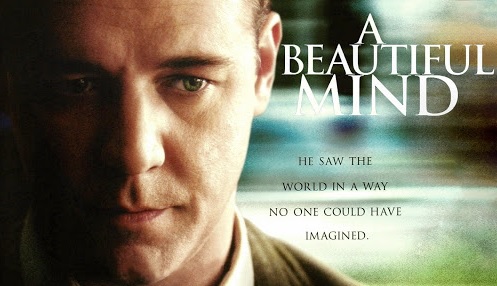
A Beautiful Mind is a 2001 American biographical drama film based on the life of the American mathematician John Nash, a Nobel Laureate in Economics and Abel Prize winner. The film was directed by Ron Howard, from a screenplay written by Akiva Goldsman. It was inspired by the bestselling, Pulitzer Prize-nominated 1998 book of the same name by Sylvia Nasar.
The film stars Russell Crowe, along with Ed Harris, Jennifer Connelly, Paul Bettany, Adam Goldberg, Judd Hirsch, Josh Lucas, Anthony Rapp, and Christopher Plummer in supporting roles. The story begins in Nash’s days as a graduate student at Princeton University. Early in the film, Nash begins to develop paranoid schizophrenia and endures delusional episodes while watching the burden his condition brings on his wife Alicia and friends.
The film opened in the United States cinemas on 21 December 2001. It went on to gross over $313 million worldwide and won four Academy Awards, for Best Picture, Best Director, Best Adapted Screenplay and Best Supporting Actress. It was also nominated for Best Actor, Best Film Editing, Best Makeup, and Best Original Score.
It was well received by critics, but has been criticised for its inaccurate portrayal of some aspects of Nash’s life, especially his other family and a son born out of wedlock. However, the filmmakers have stated that the film was not meant to be a literal representation of Nash’s life (see A Brilliant Madness (2002)).
Outline
In 1947, John Nash arrives at Princeton University as co-recipient, with Martin Hansen, of the prestigious Carnegie Scholarship for mathematics. He meets fellow math and science graduate students Sol, Ainsley, and Bender, as well as his roommate Charles Herman, a literature student. Determined to publish his own original idea, Nash is inspired when he and his classmates discuss how to approach a group of women at a bar. Hansen quotes Adam Smith and advocates “every man for himself,” but Nash argues that a cooperative approach would lead to better chances of success, and develops a new concept of governing dynamics. He publishes an article on his theory, earning him an appointment at MIT where Sol and Bender join him.
In 1953, Nash is invited to the Pentagon to crack encrypted enemy telecommunications, which he manages to decipher mentally. Bored with his regular duties at MIT, including teaching, he is recruited by the mysterious William Parcher of the United States Department of Defence with a classified assignment: to look for hidden patterns in magazines and newspapers in order to thwart a Soviet plot. Nash becomes increasingly obsessive in his search for these patterns, delivering his results to a secret mailbox, and comes to believe he is being followed.
One of his students, Alicia Larde, asks him to dinner, and they fall in love. On a return visit to Princeton, Nash runs into Charles and his niece, Marcee. With Charles’ encouragement, he proposes to Alicia and they marry. Nash fears for his life after surviving a shootout between Parcher and Soviet agents, and learns Alicia is pregnant, but Parcher blackmails him into continuing his assignment. While delivering a guest lecture at Harvard University, Nash tries to flee from people he thinks are Soviet agents, led by psychiatrist Dr. Rosen, but is forcibly sedated and committed to a psychiatric facility.
Dr. Rosen tells Alicia that Nash has paranoid schizophrenia and that Charles, Marcee, and Parcher exist only in his imagination. Alicia informs Nash that the Department of Defense does not employ a “William Parcher” and reveals the unopened documents he delivered to the secret mailbox. Nash is given a course of insulin shock therapy and eventually released. Frustrated with the depressive side effects of his antipsychotic medication, he secretly stops taking it and relapses, “meeting” Parcher again.
In 1956, Alicia discovers Nash has resumed his “assignment” in an abandoned shed near their home. Realizing he has relapsed, Alicia rushes to the house to find Nash had left their infant son in the running bathtub, believing Charles was watching the baby. Alicia calls Dr. Rosen, but Nash believes Parcher is trying to kill her and accidentally knocks her and the baby to the ground. As Alicia flees with their baby, Nash jumps in front of her car and affirms: “Marcee can’t be real! She never gets old!”, finally accepting that Parcher and other figures are hallucinations. Against Dr. Rosen’s advice, Nash chooses not to restart his medication, believing he can deal with his symptoms himself, and Alicia decides to stay and support him.
Nash returns to Princeton and approaches his old rival Hansen, now head of the mathematics department, who allows him to work out of the library and audit classes. Over the next two decades, Nash learns to ignore his hallucinations and, by the late 1970s, is allowed to teach again. In 1994, Nash wins the Nobel Prize for his revolutionary work on game theory, and is honoured by his fellow professors. At the Nobel ceremony, he dedicates his prize to his wife. As Nash, Alicia, and their son leave the auditorium in Stockholm, Nash sees Charles, Marcee, and Parcher watching him, but looks at them only briefly before departing.
Cast
Russell Crowe as John Nash.
Ed Harris as William Parcher.
Jennifer Connelly as Alicia Nash.
Christopher Plummer as Dr. Rosen.
Paul Bettany as Charles Herman.
Adam Goldberg as Richard Sol.
Josh Lucas as Martin Hansen.
Anthony Rapp as Bender.
Jason Gray-Stanford as Ainsley Neilson.
Judd Hirsch as Helinger.
Austin Pendleton as Thomas King.
Vivien Cardone as Marcee Herman.
Killian, Christian, and Daniel Coffinet-Crean as Baby.
Production
Development
After producer Brian Grazer first read an excerpt of Sylvia Nasar’s book A Beautiful Mind in Vanity Fair magazine, he immediately purchased the rights to the film. He eventually brought the project to director Ron Howard, who had scheduling conflicts and was forced to pass. Grazer later said that many A-list directors were calling with their point of view on the project. He eventually focused on a particular director, who coincidentally was available only when Howard was also available. Grazer chose Howard.
Grazer met with a number of screenwriters, mostly consisting of “serious dramatists”, but he chose Akiva Goldsman because of his strong passion and desire for the project. Goldsman’s creative take on the project was to avoid having viewers understand they are viewing an alternative reality until a specific point in the film. This was done to rob the viewers of their understanding, to mimic how Nash comprehended his experiences. Howard agreed to direct the film based on the first draft. He asked Goldsman to emphasize the love story of Nash and his wife; she was critical to his being able to continue living at home.
Dave Bayer, a professor of Mathematics at Barnard College, Columbia University, was consulted on the mathematical equations that appear in the film. For the scene where Nash has to teach a calculus class and gives them a complicated problem to keep them busy, Bayer chose a problem physically unrealistic but mathematically very rich, in keeping with Nash as “someone who really doesn’t want to teach the mundane details, who will home in on what’s really interesting”. Bayer received a cameo role in the film as a professor who lays his pen down for Nash in the pen ceremony near the end of the film.
Greg Cannom was chosen to create the makeup effects for A Beautiful Mind, specifically the age progression of the characters. Crowe had previously worked with Cannom on The Insider. Howard had also worked with Cannom on Cocoon. Each character’s stages of makeup were broken down by the number of years that would pass between levels. Cannom stressed subtlety between the stages, but worked toward the ultimate stage of “Older Nash”. The production team originally decided that the makeup department would age Russell Crowe throughout the film; however, at Crowe’s request, the makeup was used to push his look to resemble the facial features of John Nash. Cannom developed a new silicone-type makeup that could simulate skin and be used for overlapping applications; this shortened make-up application time from eight to four hours. Crowe was also fitted with a number of dentures to give him a slight overbite in the film.
Howard and Grazer chose frequent collaborator James Horner to score the film because they knew of his ability to communicate. Howard said, regarding Horner, “It’s like having a conversation with a writer or an actor or another director.” A running discussion between the director and the composer was the concept of high-level mathematics being less about numbers and solutions, and more akin to a kaleidoscope, in that the ideas evolve and change. After the first screening of the film, Horner told Howard: “I see changes occurring like fast-moving weather systems.” He chose it as another theme to connect to Nash’s ever-changing character. Horner chose Welsh singer Charlotte Church to sing the soprano vocals after deciding that he needed a balance between a child and adult singing voice. He wanted a “purity, clarity and brightness of an instrument” but also a vibrato to maintain the humanity of the voice.
The film was shot 90% chronologically. Three separate trips were made to the Princeton University campus. During filming, Howard decided that Nash’s delusions should always be introduced first audibly and then visually. This provides a clue for the audience and establishes the delusions from Nash’s point of view. The historic John Nash had only auditory delusions. The filmmakers developed a technique to represent Nash’s mental epiphanies. Mathematicians described to them such moments as a sense of “the smoke clearing”, “flashes of light” and “everything coming together”, so the filmmakers used a flash of light appearing over an object or person to signify Nash’s creativity at work. Two night shots were done at Fairleigh Dickinson University’s campus in Florham Park, New Jersey, in the Vanderbilt Mansion ballroom. Portions of the film set at Harvard were filmed at Manhattan College.
Many actors were considered for the role of John Nash, including Bruce Willis, Kevin Costner, John Travolta, Tom Cruise. Howard ultimately cast Russell Crowe.
Writing
The narrative of the film differs considerably from the events of Nash’s life, as filmmakers made choices for the sense of the story. The film has been criticised for this aspect, but the filmmakers said they never intended a literal representation of his life.
One difficulty was the portrayal of his mental illness and trying to find a visual film language for this. Sylvia Nasar said that the filmmakers “invented a narrative that, while far from a literal telling, is true to the spirit of Nash’s story”. Nash spent his years between Princeton and MIT as a consultant for the RAND Corporation in California, but in the film he is portrayed as having worked for the Department of Defense at the Pentagon instead. His handlers, both from faculty and administration, had to introduce him to assistants and strangers. The PBS documentary A Brilliant Madness (2002) tried to portray his life more accurately.
Few of the characters in the film, besides John and Alicia Nash, correspond directly to actual people. The discussion of the Nash equilibrium was criticized as over-simplified. In the film, Nash suffers schizophrenic hallucinations while he is in graduate school, but in his life he did not have this experience until some years later. No mention is made of Nash’s homosexual experiences at RAND, which are noted in the biography, though both Nash and his wife deny this occurred. Nash fathered a son, John David Stier (born 19 June 1953), by Eleanor Agnes Stier (1921-2005), a nurse whom he abandoned when she told him of her pregnancy. The film did not include Alicia’s divorce of John in 1963. It was not until after Nash won the Nobel Memorial Prize in 1994 that they renewed their relationship. Beginning in 1970, Alicia allowed him to live with her as a boarder. They remarried in 2001.
Nash is shown to join Wheeler Laboratory at MIT, but there is no such lab. Instead, he was appointed as C. L. E. Moore instructor at MIT, and later as a professor. The film furthermore does not touch on the revolutionary work of John Nash in differential geometry and partial differential equations, such as the Nash embedding theorem or his proof of Hilbert’s nineteenth problem, work which he did in his time at MIT and for which he was given the Abel Prize in 2015. The so-called pen ceremony tradition at Princeton shown in the film is completely fictitious. The film has Nash saying in 1994: “I take the newer medications”, but in fact, he did not take any medication from 1970 onwards, something highlighted in Nasar’s biography. Howard later stated that they added the line of dialogue because they worried that the film would be criticised for suggesting that all people with schizophrenia can overcome their illness without medication. In addition, Nash never gave an acceptance speech for his Nobel prize.
Release
A Beautiful Mind received a limited release on 21 December 2001, receiving positive reviews, with Crowe receiving wide acclaim for his performance. It was later released in the United States on 04 January 2002.
Box Office
During the five-day weekend of the limited release, A Beautiful Mind opened at the #12 spot at the box office, peaking at the #2 spot following the wide release. The film went on to gross $170,742,341 in the United States and Canada and $313,542,341 worldwide.
Home Media
A Beautiful Mind was released on VHS and DVD, in wide- and full-screen editions, in North America on 25 June 2002. The DVD set includes audio commentaries, deleted scenes and documentaries. The film was also released on Blu-ray in North America on 25 January 2011.
Production & Filming Details
Director(s): Ron Howard.
Producer(s): Brian Grazer and Ron Howard.
Writer(s): Akiva Goldsman.
Music: James Horner.
Cinematography: Roger Deakins.
Editor(s): Daniel P. Hanley and Mike Hill.
Production: Imagine Entertainment.
Distributor(s): Universal Pictures (North America) and DreamWorks Pictures (International).
Release Date: 13 December 2001 (Beverly Hills Premiere) and 01 December 2001 (US).
A science documentary hosted by Liev Schreiber, published by PBS in 2002 with English narration.
Part of the American Experience series.
Outline
John Nash, often called one of the most remarkable mathematicians in history, tells his version of the strange, tragic and inspiring events that took him from genius to immobilising illness to the Nobel Prize.
Suffering a devastating breakdown at the age of 30 and later diagnosed with schizophrenia, Nash was the focus of the 2001 Oscar-winning film ‘A Beautiful Mind‘.
Production & Filming Details
Director(s): Marks Samuels.
Producer(s):
Margaret Drain … executive producer.
Sharon Grimberg … series editor.
Randall MacLowry … producer.
Melissa Martin … associate producer.
Susan Mottau … coordinating producer.
Mark Samels … senior producer.
Greg Shea … post production producer.
Writer(s): Marks Samuels and Randall MacLowery.
Music: Tom Philips.
Cinematography: Peter Donahue.
Editor(s): Karen Schmeer.
Production:
WGBH Educational Foundation.
WGBH.
Yellow Jersey Films (as A Yellow Jersey Films Production for American Experience).















 Mental Health Matters
You must be logged in to post a comment.