Book: A Dictionary of Psychology 4/e

Book Title:

A Dictionary of Psychology 4/e (Oxford Quick Reference).

Author(s): Andrew M. Colman.

Year: 2015.

Edition: Fourth (4th).

Publisher: Oxford OUP.

Type(s): Paperback and Kindle.

Synopsis:

Including more than 11,000 definitions, this authoritative and up-to-date dictionary covers all branches of psychology. Clear, concise descriptions for each entry offer extensive coverage of key areas including cognition, sensation and perception, emotion and motivation, learning and skills, language, mental disorder, and research methods. The range of entries extends to related disciplines including psychoanalysis, psychiatry, the neurosciences, and statistics. Entries are extensively cross-referenced for ease of use, and cover word origins and derivations as well as definitions. More than 100 illustrations complement the text.

This fourth edition has incorporated a large number of significant revisions and additions, many in response to the 2013 publication of the American Psychiatric Association’s latest edition of Diagnostic and Statistical Manual of Mental Disorders, bringing the Dictionary fully up to date with the most recent literature of the subject.

In addition to the alphabetical entries, the dictionary also includes appendices covering over 800 commonly used abbreviations and symbols, as well as a list of phobias and phobic stimuli, with definitions.

Comprehensive and clearly written, this dictionary is an invaluable work of reference for students, lecturers, and the general reader with an interest in psychology.
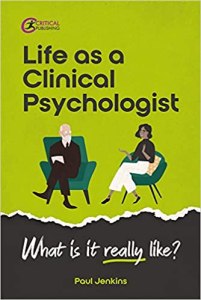
Book: Life as a Clinical Psychologist: What is it Really Like?

Book Title:

Life as a Clinical Psychologist: What is it Really Like?

Author(s): Paul Jenkins.

Year: 2020.

Edition: First (1st).

Publisher: Critical Publishing.

Type(s): Paperback and Kindle.

Synopsis:

Considering a career as a Clinical Psychologist? This book is an ideal, jargon-free introduction for those wishing to find out more about working in this demanding but rewarding mental health profession.

An accessible text that invites you to think critically about whether becoming a Clinical Psychologist is right for you, questioning and challenging your views and providing an honest perspective of life as a clinical psychologist.

Written from personal experience of over 10 years working in applied psychology, with a unique knowledge of the practice, theory, and application of Clinical Psychology, Paul Jenkins provides a first-hand perspective, blending anecdotes with factual advice on the clinical academic culture. It is also packed with case studies which highlight a range of different career pathways (including in other mental health fields) and includes coverage of post-qualification life to gives the reader a sense of the career you can have after training.

Book: Drop the Disorder! Challenging the Culture of Psychiatric Diagnosis

Book Title:

Drop the Disorder! Challenging the Culture of Psychiatric Diagnosis.

Author(s): Jo Watson.

Year: 2019.

Edition: First (1st).

Publisher: PCCS Books.

Type(s): Paperback and Kindle.

Synopsis:

In October 2016 Jo Watson hosted the very first A Disorder for Everyone!’ event in Birmingham, with psychologist Dr Lucy Johnstone, to explore (and explode) the culture of psychiatric diagnosis in mental health. To provide a space to continue the debate after the event, Jo also set up the now hugely popular and active Facebook group Drop the Disorder!’.; Since then, they have delivered events in towns and cities across the UK, bringing together activists, survivors and professionals to debate psychiatric diagnosis. How and why does psychiatric diagnosis hold such power? What harm it can do? What are the alternatives to diagnosis, and how it can be positively challenged?; This book takes the themes, energy and passions of the AD4E events – bringing together many of the event speakers with others who have stories to tell and messages to share in the struggle to challenge diagnosis.; This is an essential book for everyone of us who looks beyond the labels.

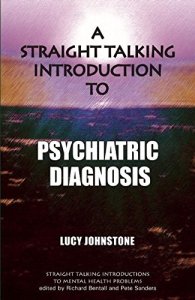
Book: A Straight Talking Introduction to Psychiatric Diagnosis

Book Title:

A Straight Talking Introduction to Psychiatric Diagnosis (Straight Talking Introductions).

Author(s): Lucy Johnstone.

Year: 2014.

Edition: First (1st).

Publisher: PCCS Books.

Type(s): Paperback and Kindle.

Synopsis:

Do you still need your psychiatric diagnosis? This book will help you to decide. A revolution is underway in mental health. If the authors of the diagnostic manuals are admitting that psychiatric diagnoses are not supported by evidence, then no one should be forced to accept them. If many mental health workers are openly questioning diagnosis and saying we need a different and better system, then service users and carers should be allowed to do so too. This book is about choice. It is about giving people the information to make up their own minds, and exploring alternatives for those who wish to do so.

Book: A Straight-talking Introduction to Children’s Mental Health Problems

Book Title:

A Straight-talking Introduction to Children’s Mental Health Problems (Straight Talking Introductions).

Author(s): Sami Timimi (Author), Richard Bentall (Editor), and Pete Sanders (Editor).

Year: 2009.

Edition: First (1st).

Publisher: PCCS Books.

Type(s): Paperback and Kindle.

Synopsis:

Rates of diagnosis of psychiatric disorders such as ADHD, and the subsequent prescription of psychiatric drugs in children, have increased alarmingly over recent years. Yet diagnoses are supported by very little scientific evidence and the effectiveness and safety of drugs for children is highly questionable. Unlike medications, psychotherapeutic or ‘talking therapies’ with children, adolescents and their families have established themselves as both safe and effective. Here, Sami Timimi arms you with some of the information you’ll need to make informed choices about a child’s diagnosis and treatment. He provides an honest account of the dangers of medicating children or adolescents and discusses alternative therapies. He also describes practical advice on things parents can try themselves, common pitfalls to avoid, and how to find the professionals you need.

Book: Insane Medicine: How the Mental Health Industry Creates Damaging Treatment Traps and How you can Escape Them

Book Title:

Insane Medicine: How the Mental Health Industry Creates Damaging Treatment Traps and How you can Escape Them.

Author(s): Sami Timimi.

Year: 2021.

Edition: First (1st).

Publisher: Independently Published.

Type(s): Paperback and Kindle.

Synopsis:

This book digs through the rotten undergrowth which fertilises the mental health industry. The level of failure and deceit is hard to believe. The diagnoses we use are more akin to astrological than medical constructs. We have no medical tests and despite apparent innovations in drugs and therapy, five decades of research has shown no improvement in outcomes from treatment and instead an increase in the numbers categorised as severely mentally ill. Worse, we have convinced the population that they are experiencing pandemics of mental disorders, leading us to fear our ordinary emotions and to scythe away at our natural resilience. There can be no doubt that the mental health industry has caused more harm than good. In this hard hitting book, Dr Timimi, a child psychiatrist with over 30-years-experience as a practicing clinician and researcher, reveals the shocking truth about the unintended harms this industry has caused, both to those in distress and our culture more broadly. He explains how our institutional ideology traps people into becoming long-term patients and proposes a simple theory that explains why more people become long term patients than get better as well as sharing tips on how those caught in this trap can find safe ways back to health and contentment. A revolution in mental health care is inevitable. The current systems have failed and are un-reformable. They will be overthrown. This book will tell you why.

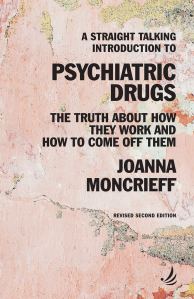
Book: A Straight Talking Introduction to Psychiatric Drugs: The Truth About How They Work and How to Come Off Them

Book Title:

A Straight Talking Introduction to Psychiatric Drugs: The Truth About How They Work and How to Come Off Them (The Straight Talking Introduction Series).

Author(s): Joanna Moncrieff.

Year: 2020.

Edition: Second (2nd), Revised Edition.

Publisher: PCCS Books.

Type(s): Paperback and Kindle.

Synopsis:

In an era when more people are taking psychiatric drugs than ever before, Joanna Moncrieff’s explosive book challenges the claims for their mythical powers. Drawing on extensive research, she demonstrates that psychiatric drugs do not ‘treat’ or ‘cure’ mental illness by acting on hypothesised chemical imbalances or other abnormalities in the brain. There is no evidence for any of these ideas. Moreover, any relief the drugs may offer from the distress and disturbance of a mental disorder can come at great cost to people’s physical health and their ability to function in day-to-day life. And, once on these drugs, coming off them can be very difficult indeed. This book is a wake-up call to the potential damage we are doing to ourselves by relying on chemical cures for human distress. Its clear, concise explanations will enable people to make a fully informed decision about the benefits and harms of these drugs and whether and how to come off them if they so choose.

Book: The Art and Science of Mental Health Nursing

Book Title:

The Art and Science of Mental Health Nursing: Principles and Practice.

Author(s): Ian Norman and Iain Ryrie (Editors).

Year: 2018.

Edition: Fourth (4th).

Publisher: Open University Press.

Type(s): Paperback and Kindle.

Synopsis:

This well-established textbook is a must-buy for all mental health nursing students and nurses in registered practice. Comprehensive and broad, it explores how mental health nursing has a positive impact on the lives of people with mental health difficulties.

Book: A Straight Talking Introduction to the Power Threat Meaning Framework: An Alternative to Psychiatric Diagnosis

Book Title:

A Straight Talking Introduction to the Power Threat Meaning Framework: An Alternative to Psychiatric Diagnosis (The Straight Talking Introduction Series).

Author(s): Mary Boyle and Lucy Johnstone.

Year: 2020.

Edition: First (1st).

Publisher: PCCS Books.

Type(s): Paperback and Kindle.

Synopsis:

The current mainstream way of describing psychological and emotional distress assumes it is the result of medical illnesses that need diagnosing and treating. This book summarises a powerful alternative to psychiatric diagnosis that asks not ‘What’s wrong with you?’ but ‘What’s happened to you?’ The Power Threat Meaning Framework (PTMF) was co-produced by a core group of psychologists and service users and launched in 2018, prompting considerable interest in the UK and worldwide. It argues that emotional distress, unusual experiences and many forms of troubled or troubling behaviour are understandable when viewed in the context of a person’s life and circumstances, the cultural and social norms we are expected to live up to and the degree to which we are exposed to trauma, abuse, injustice and inequality. The PTMF offers all of us the tools to create new, hopeful narratives about the reasons for our distress that are not based on psychiatric diagnosis and to find ways forward as individuals, families, social groups and whole societies.

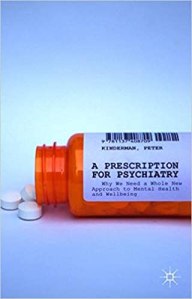
Book: A Prescription for Psychiatry: Why We Need a Whole New Approach to Mental Health and Wellbeing

Book Title:

A Prescription for Psychiatry: Why We Need a Whole New Approach to Mental Health and Wellbeing.

Author(s): Peter Kinderman.

Year: 2014.

Edition: First (1st).

Publisher: Palgrave Macmillan.

Type(s): Paperback and Kindle.

Synopsis:

A Prescription for Psychiatry lays bare the flaws and failings of traditional mental health care and offers a radical alternative. Exposing the old-fashioned biological ‘disease model’ of psychiatry as unscientific and unhelpful, it calls for a revolution in the way we plan and deliver care. Kinderman challenges the way we think about mental health problems, arguing that the origins of distress are largely social, and urges a change from a ‘disease model’ to a ‘psychosocial model’. The book persuasively argues that we should significantly reduce our use of psychiatric medication, and help should be tailored to each person’s unique needs. This is a manifesto for an entirely new approach to psychiatric care; one that truly offers care rather than coercion, therapy rather than medication, and a return to the common sense appreciation that distress is usually an understandable reaction to life’s challenges.