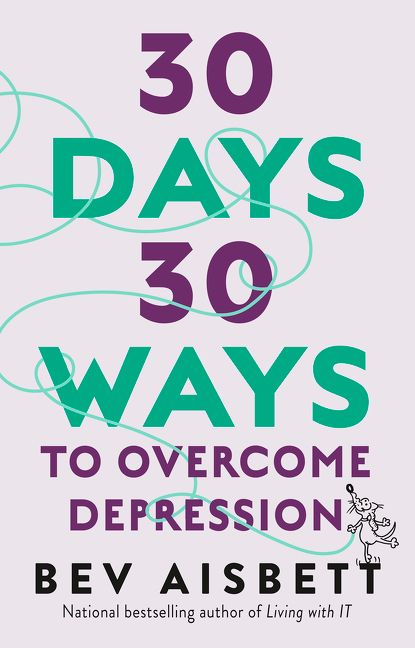
Book: 30 Days 30 Ways To Overcome Depression

Book Title: 30 Days 30 Ways to Overcome Depression

Author: Bev Aisbett.

Year: 2019.

Publisher: HarperCollins, London, UK.

Synopsis:

From bestselling author Bev Aisbett comes a proven, practical and simple workbook to help people manage their depression, with a month’s worth of daily strategies and exercises for work and for home.

When you’re suffering from depression, sometimes it’s as much as you can do to get out of bed, let alone read a book. But this just isn’t any other book. This is a practical day-by-day workbook, with clear, simple daily building blocks and exercises designed to help pull you out of the inertia of depression. It’s a highly approachable, concise and above all practical way to help manage depression.

Featuring all-new material from experienced counsellor and bestselling author of the self-help classics Living with IT and Taming the Black Dog, Bev Aisbett has based this book on many of the exercises she has been teaching and writing about for the past twenty years to help people manage their depression.

Book: Lost Connections

Book Title: Lost Connections: Uncovering the Real Causes of Depression – and the Unexpected Solutions.

Author: Johann Hari.

Year: 2018.

Publisher: Bloomsbury Circus, 50 Bedford Square, London, UK.

Synopsis:

A radically new way of thinking about mental health. What really causes depression and anxiety – and how can we really solve them? Award-winning journalist Johann Hari suffered from depression since he was a child and started taking anti-depressants when he was a teenager. He was told that his problems were caused by a chemical imbalance in his brain. As an adult, trained in the social sciences, he began to investigate whether this was true – and he learned that almost everything we have been told about depression and anxiety is wrong.

Across the world, Hari found social scientists who were uncovering evidence that depression and anxiety are largely caused by key problems with the way we live today. Hari’s journey took him from a mind-blowing series of experiments in Baltimore, to an Amish community in Indiana, to an uprising in Berlin. Once he had uncovered nine real causes of depression and anxiety, they led him to scientists who are discovering seven very different solutions – ones that work.

Mental Health: Exercise & Osteoarthritis in Older People

Research Paper Title

A Study on the Physical Activities, Mental Health, and Health-Related Quality of Life of Osteoarthritis Patients.

Background

The purpose of this study was to investigate the physical activities, mental health, and health-related quality of life (HRQOL) of osteoarthritis patients.

Methods

This study was conducted using data from the first year of the 7th Korea National Health and Nutritional Examination Survey.

There were 8,150 participants included in the survey, and 665 participants had been diagnosed with osteoarthritis.

This study analysed the measurements of physical activities, depression, and HRQOL in participants with osteoarthritis.

Results

The mean age of the participants was 67 ± 9.9 years and 83.1% were female.

Participants rarely engaged in work-related physical activity, and engaged in leisure-related physical activities infrequently.

Most of the participants (85.9%) did not do regular exercise, but 1/3 of the participants walked for over 10 minutes a day.

“Pain/discomfort” had the least impact upon HRQOL, and among the depression subcategories, “difficult to sleep and tiredness” had the most impact.

Multiple logistic regression analysis showed that an adverse HRQOL score was statistically significantly associated with “location changes/physical activities” (p < 0. 01), “depression” (p < 0.001) and “age” (p < 0.001).

Conclusions

Exercise programmes should be in place which are manageable in everyday life for the elderly (> 65 years).

Changes in daily routine so that patients become more active, should be supported by the family and community, together with assistance in managing psychological problems such as depression.

Reference

Kim, D.J. (2019) A Study on the Physical Activities, Mental Health, and Health-Related Quality of Life of Osteoarthritis Patients. Osong Public Health and Research Perspectives. 10(6), pp.368-375. doi: 10.24171/j.phrp.2019.10.6.07.

Does Depression Alter Brain Structure?

Research suggests our brain looks different if we have depression.

These differences seem to be caused by depression, rather than precede it.

When neuroscientists compare the brains of individuals with and without depression, there are common dissimilarities.

For example, individuals with depression tend to have a smaller hippocampus, a brain region important in forming memories.

However, it has been difficult to work out whether such differences cause the symptoms of depression or result from the disorder.

To try and find out which, Heather Whalley and her colleagues at the University of Edinburgh made use of two huge genetic databases.

  • Consumer genetic testing company 23andMe holds information on the DNA and depressive symptoms of tens of thousands of individuals; and
  • The UK Biobank collects DNA, lifestyle and behaviour questionnaires and brain scans from thousands more.

Whalley and colleagues used this, as well as earlier research, to create a polygenic risk score (PRS) for depression (A PRS assigns weight to various genetic factors thought to contribute to the risk of a condition).

They made sure the PRS worked by testing it in a separate group of 11,214 people. They then assessed the brain scans and behaviour records of individuals with a PRS that put them at risk of depression. Individuals with higher genetic risk tended to have less white matter in their brains, and it did not seem to function as well. White matter is the tissue that makes up most of our brains.

Whalley and her colleagues then analysed how closely both brain structure and symptoms of depression were related to genetic factors.

Genes are present from birth, so if genetic factors are more closely linked to symptoms, for example, that suggests the symptoms were present before the brain structure differences.

They found that many brain differences appear to be caused by depression. There was one exception: differences in a brain structure called the anterior thalamic radiation appear to come before depression (Shen, Howard & Adams, 2019).

This suggests the genes that puts an individual at risk of depression do so via this structure.

Whalley’s team also found that a combination of childhood trauma and poverty leaves individuals at greatest risk of depression.

Behaviours linked to depression could end up impacting the brain’s white matter connections more generally. It might be that patients with depression do not use some of the brain connections that others would use.

Being socially withdrawn, or focusing more on the negative than the positive, could have an effect. For example, it is known that if we do not use a pathway in the brain, that pathway starts to shrink.

References

Hamzelou, J. (2019) Depression Alters Brain Structure. New Scientist. 19 October 2019, pp.16.

Shen, X., Howard, D.M. & Adams, M.J. (2019) A phenome-wide association and Mendelian Randomisation study of polygenic risk for depression in UK Biobank. Available from World Wide Web: https://www.biorxiv.org/content/10.1101/617969v1. [Accessed: 31 January, 2020].

Meditation & Mindfulness

“Explain your work in one easy paragraph.

I am a Buddhist monk who teaches meditation and mindfulness. I’m interested in the application of Buddhist philosophy to the problems of modern life. Meditation is training for the mind, helping us become less controlled by stressful thoughts and emotions. Mindfulness brings the benefits of meditation into daily life. I am also interested in the interface between Buddhism and science, and I frequently collaborate with neuroscientists and medics.

How did you become a monk?

I had an extreme burnout 26 years ago due to high levels of stress, and I went to a Buddhist monastery to find answers. I loved it so much, I decided to remain a monk.

Did you have to overcome any particular challenges to get where you are today?

I used to have bouts of depression and anxiety, so my journey has involved quite a few rocky patches. I do, however, feel that these struggles have helped me to grow and discover valuable knowledge that I can share with others.” (Thubten, 2019, p.56).

Reference

Thubten, G. (2019) The Back Pages: The Q&A. New Scientist. 05 October 2019.

Owning & Managing a Business Can be Hazardous to your Mental Health

1.0 Introduction

Owning and Managing a Business Can be Hazardous to your Mental Health.

This article provides an overview of business ownership in the context of mental health.

If you are one of the millions of small and medium business owners around the globe, you probably have a good idea of how tough (and sometimes lonely) it can be at the top of the business – and how owning and managing your own business can be hazardous to your mental health.

It is well-known that our mental health can deteriorate, for a variety of reasons, and, if left unchecked, can lead to mental health problems.

Although depression and anxiety are likely to be the most common issues an owner faces, it is important to remember that mental health symptoms and conditions come in many forms.

2.0 Why Be a Business Owner?

Many of us are drawn to small business because working for others provides its own stresses, for example, the feeling of lost control as others make decisions we may feel unable to influence.

Being a business owner offers a level of freedom and control that we may be unable to achieve as an employee.

3.0 Factors Affecting Mental Health in Owners

Although the symptoms of mental health conditions can be similar between people, the triggers can be very different.

There are a number of factors that could lead to a deterioration in a business owner’s mental health, including:

  • Excessive stress;
  • A toxic work environment;
  • Poor leadership;
  • Uncertainty;
  • Long hours;
  • A lack of sleep; and
  • So on.

These can lead to burnout which, in turn, can lead to mental health conditions such as anxiety and depression.

Increased competition in your particular market or industry means added pressure to perform and stand out from the crowd, as well as potentially making it more difficult to be financially successful. Business costs may also be rising, possibly faster than your ability to increase sales and revenue – meaning the bottom line is impacted, aka less profit.

Using a contemporaneous example, the business uncertainty surrounding Brexit, especially for export-orientated businesses, can have a profound impact on business planning and sales generation.

4.0 A Blur between Personal, Family & Work

Small business ownership, especially, can be tough because there are few support structures for owners.

As an owner, you are responsible for everything and the lines between personal and family pressures and work are blurred or even non-existent.

Finally, the financial pressures are very real, as it is the owner’s money at stake not a large company’s money.

5.0 I’m In Control!

Business owners may be reluctant to seek, ask or talk about any mental health issues they may be facing due to the need to be perceived as having everything under control.

This means that business owners can, effectively, end up in rather stressful jobs.

With this in mind, most employees will be unaware of the stress attached to owning a business and how challenging cashflow, for example, can be. When margins are tight, paying wages can be extremely stressful. There are real life examples where owners have paid staff wages through their credit cards or overdrafts to ensure their employees get paid – mainly due to a feeling of guilt and not wanting to let them down. It can be stressful knowing that your employee’s family relies on the wage you are paying their loved one.

There is also the stress on marriages, especially if a couple is in business together.

6.0 The Value of Mentors

Other business owners understand what you, as a business owner, are going through. They understand the impact that long hours, for example, can have on the owner’s well-being and their families.

A business mentor can assist by helping the owner find ways of being more effective with their time, among other things.

7.0 Addressing Mental Health Issues

It is imperative that you do not do nothing.

There are a number of things owners can do, at both at an individual and organisational level:

  • Know the risks to mental health and well-being in your business.
    • What are the triggers?
  • Talk about mental health and well-being.
    • This helps to normalise it.
  • Leaders in your business need to be on board.
    • They must send the message to all staff that the business takes mental health seriously.
    • Role model what good mental health looks like and what we do when someone needs our help.
  • Get some education around mental health.
    • The reason that myths and fear exist is because of lack of awareness and knowledge.
    • There are workshops, coaches and even online courses now which help plug this knowledge gap.
  • Have the conversation with your people.
    • Not saying anything to someone who is struggling is not the way to go.
    • Simply asking “Are you OK?” is a really good start and shows the person that you have noticed and do care.
  • Sleep, nutrition, relationships and exercise all correlate with mental health, so check in on your people to see how they are going with these areas.
    • For example, if someone tells you that they have not been sleeping for two months, that is going to take its toll and something needs to be done.
  • Know who to go to.
    • Have an accessible list of contacts that you can call on for a range of different mental health and well-being matters.

It is important to seek support from someone who:

  • Has received appropriate training;
  • Is a registered practitioner; and
  • Has frequent supervision.

8.0 Pursing Good Mental Health

In the pursuit of good mental health, it is important to:

  • Understand our stressors;
  • Name our stressors;
  • Admit they exist; and
  • Aim to avoid them.

If our stressors cannot be avoided, we should attempt to better manage them.

Finally, when possible, it is important as a business owner to make time and take personal care of yourself.

Can Mushrooms be the New Cannabis?

In the attached article, from The Economist, investors are hoping that medical psychedelics will be the new cannabis.

It briefly looks at how Ketamine and psilocybin (which gives mushrooms their magic) are being researched for their potential effects on psychiatric conditions such as depression, anxiety, and addiction.

Reference

The Economist. (2019) Medical Psychedelics: Shroom to Grow. The Economist. 16 October 2019.

Polycythemia, Mental Health & the Great East Japan Earthquake

Research Paper Title

Relationship between the prevalence of polycythemia and factors observed in the mental health and lifestyle survey after the Great East Japan Earthquake.

Background

The researchers have been examining the Comprehensive Health Check of the Fukushima Health Management Survey of residents of 13 municipalities who were forced by the government to evacuate due to the 2011 Great East Japan Earthquake (GEJE).

Their findings showed that evacuation is a risk factor for polycythemia and suggested that experiencing an unprecedented disaster and exposure to chronic stress due to evacuation might be a cause of polycythemia.

Methods

The researchers analysed the relationship between the prevalence of polycythemia and the following factors observed in the Mental Health and Lifestyle Survey in an observational study with a cross-sectional design:

  • Traumatic symptoms;
  • Depression status;
  • Socioeconomic factors such as residential environment; and
  • Working situation after the GEJE.

Target population of the survey included men and women who were at least 15 years of age and who lived in the evacuation zones specified by the government.

Participants analysed consisted of 29,474 persons (12,379 men and 16,888 women) who had participated in both the 2011 Comprehensive Health Check and Mental Health and Lifestyle Survey from June 2011 through March 2012.

Results

The prevalence of polycythemia was not associated with mental states associated with traumatic symptoms (Post-Traumatic Stress Disorder Checklist Scale ≥ 44) and depression status (Kessler 6-item Scale ≥ 13).

Furthermore, multivariate analysis showed that there was a tendency for males to develop polycythemia, with characteristics such as:

  • Being aged 65 years and older;
  • Highly educated;
  • Obese (body mass index ≥ 25);
  • Hypertensive;
  • Diabetic;
  • Having liver dysfunction; and
  • A smoker being significantly related to the prevalence of polycythemia.

Conclusions

The researchers state their findings conclusively demonstrated that polycythemia was not significantly related to psychological factors, but was significantly related to the onset of lifestyle-related disease after the GEJE.

Reference

Sakai, A., Nakano, H., Ohira, T., Maeda, M., Okazaki, K., Takahashi, A., Kawasaki, Y., Satoh, H., Ohtsuru, A., Shimabukuro, M., Kazama, J., Hashimoto, S., Hosoya, M., Yasumura, S., Yabe, H., Ohto, H., Kamiya, K. & Fukushima Health Management Survey Group. (2020) Relationship between the prevalence of polycythemia and factors observed in the mental health and lifestyle survey after the Great East Japan Earthquake. Medicine (Baltimore). 99(1):e18486. doi: 10.1097/MD.0000000000018486.

Slash Anxiety, Depression, & Stress Levels with a Whole Foods Diet

For those already struggling with their New Year eating resolutions, they may be happy to hear that it can take under a month to see improvements in how they feel after adopting a healthy diet.

A randomised control study, conducted by researchers at Macquarie University in Australia, found that when depressed university students, aged between 17 and 35, switched from a processed diet to a whole foods diet anxiety, depression, and stress levels were slashed.

The whole foods diet included (per day):

  • Two or three servings of fruit.
  • Five portions of vegetables.
  • Three servings each of wholegrains and lean protein.
  • Two tablespoons of olive oil.
  • One teaspoon of turmeric or cinnamon.

4 Quick Tips for Coping with Depression

Four quick tips for those with a friend or relative with depression.

  1. Be aware that depression can be a hidden illness.
    • You may not know that someone close to you is struggling.
    • Keep an eye out for any telltale signs.
  2. Be there for your relative or loved one.
    • Even though they will not necessarily always appreciate it.
  3. Stay in touch with someone if you think they are struggling.
    • An individual with depression may try to withdraw and not contact you, but do not take it personally.
    • Be proactive when it comes to keeping in contact.
  4. Offer support as best you can.
    • But do not forget to also look after yourself.