Type(s): Hardcover, Paperback, Audiobook, and Kindle.
Synopsis:
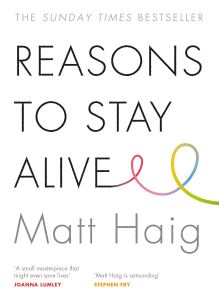
Aged 24, Matt Haig’s world caved in. He could see no way to go on living. This is the true story of how he came through crisis, triumphed over an illness that almost destroyed him and learned to live again.
A moving, funny and joyous exploration of how to live better, love better and feel more alive, Reasons to Stay Alive is more than a memoir. It is a book about making the most of your time on earth.
“I wrote this book because the oldest clichés remain the truest. Time heals. The bottom of the valley never provides the clearest view. The tunnel does have light at the end of it, even if we haven’t been able to see it . . . Words, just sometimes, really can set you free.”
Psychiatrists begin to map genetic architecture of mental disorders.
Background
Mental illness affects one in six US adults, but scientists’ sense of the underlying biology of most psychiatric disorders remains nebulous.
That is frustrating for physicians treating the diseases, who must make diagnoses based on symptoms that may only appear sporadically.
Now, a large-scale analysis of postmortem brains is revealing distinctive molecular traces in people with mental illness.
An international team of researchers reports that five major psychiatric disorders have often overlapping patterns of gene activity, which furthermore vary in disease-specific – and sometimes counterintuitive – ways.
The findings, they say, might someday lead to diagnostic tests, and one has already inspired a clinical trial of a new way to treat overactive brain cells in autism.
Reference
Dengler, R. (2020) Psychiatrists begin to map genetic architecture of mental disorders. Neuroscience. 359(6376), pp.619. DOI: 10.1126/science.359.6376.619
Mental: Everything You Never Knew You Needed to Know about Mental Health.
Author(s): Dr Steve Ellen and Catherine Deveny.
Year: 2018.
Edition: First (1st).
Publisher: Anima.
Type(s): Hardcover, Paperback, Audiobook, and Kindle.
Synopsis:
How do we define mental illness? What does a diagnosis mean? What should you ask your doctor before you begin treatment? Are there alternatives to medication? What does the research show actually works?
Practitioner and professor of psychiatry Dr Steve Ellen and popular comedian Catherine Deveny combine forces to demystify the world of mental health. Sharing their personal experiences of mental illness and an insider perspective on psychiatry, they unpack the current knowledge about conditions and treatments coveing everything from depression and anxiety to schizophrenia, personality disorders and substance abuse.
Whether you have a mental illness or support someone who does, Mental offers clear practical help, empowering you with an arsenal of tips and techniques to help build your resilience.
Mental Health and Well-being in Primary Education: A Practical Guide and Resource.
Author(s): Laura Meek, Jo Phillips, and Sarah Jordan.
Year: 2020.
Edition: First (1st).
Publisher: Luminate.
Type(s): Paperback and Kindle.
Synopsis:
Good mental health is much more than the absence of mental illness – it also means having self-belief and the resilience to cope with stress and change. In order to teach such skills, teachers and other education professionals must equip themselves and their workplaces with the procedures, understanding and confidence required to monitor mental health, share concepts effectively, identify warning signs and act appropriately if issues arise.
Written by an author team combining clinical and teaching expertise, Mental Health and Wellbeing in Primary Education puts all the information you need at your fingertips with detailed guidance on creating a culture of wellbeing, overviews of how a wide variety of common mental health problems including anxiety, anger and ADHD are typically diagnosed and managed, warning signs to look out for, and a range of ready-made forms, exercises and lesson plans.
The authors propose a new approach to the definition of mental health, different than the definition proposed by the World Health Organisation, which is established around issues of person’s well-being and productivity.
It is supposed to reflect the complexity of human life experience.
Introduction
The definition of mental health proposed by the World Health Organization (WHO) is organised around a hedonic and eudaimonic perspective, in which a key role is assigned to person’s well-being and productivity. While regarding well-being as a desirable goal for many people, its inclusion in the definition of mental health raises concerns. According to Keyes, well-being includes emotional, psychological and social well-being, and involves positive feelings (e.g., happiness, satisfaction), positive attitudes towards own responsibilities and towards others, and positive functioning (e.g., social integration, actualisation and coherence).
However, people in good mental health experience a wide range of emotions, such as sadness, anger or unhappiness; most adolescents are often unsatisfied, unhappy about present social organisation and may lack social coherence. Does this mean that they are not in good mental health? A person responsible for her/his family might feel desperate after being fired from his/her job, especially in a situation characterised by scarce occupational opportunities; should we question her/his mental health? Actually, raising the bar of mental health may create unrealistic expectations, encourage people to mask most of their emotions while pretending constant happiness, and even favour their isolation when they feel sad, angry or worried.
Also the concept of positive functioning (“can work productively and fruitfully”), in line with the eudaimonic tradition, raises concerns, as it implies that a person at an age or in a physical or even political condition preventing her/him from working productively is not by definition in good mental health.
The definition of mental health is clearly influenced by the culture that defines it. However, as also advocated by Vaillant, an effort can be made to identify elements that have a universal importance for mental health, as for example, vitamins and the four basic food groups are universally given a key role in eating habits, in spite of cultural differences.
Galderisi, S., Heinz, A., Kastrup, M., Beezhold, J. & Sartorius, N. (2020) A proposed new definition of mental health. Psychiatria Polska. 51(3), pp.407-411. doi: 10.12740/PP/74145. Epub 2017 Jun 18.
Real-Time Data Collection to Examine Relations Between Physical Activity and Affect in Adults With Mental Illness.
Author(s): Danielle R. Madden, Chun Nok Lam, Brian Redline, Eldin Dzubur, Harmony Rhoades, Stephen S. Intille, Genevieve F. Dunton, and Benjamin Henwood.
Year: 2020.
Journal: Journ of Sport and Exercise Psychology, 6, pp.1-8.
DOI: doi: 10.1123/jsep.2019-0035. Online ahead of print.
Abstract:
Adults with serious mental illness engage in limited physical activity, which contributes to significant health disparities. This study explored the use of both ecological momentary assessments (EMAs) and activity trackers in adults with serious mental illness to examine the bidirectional relationship between activity and affect with multilevel modelling.
Affective states were assessed up to seven times per day using EMA across 4 days. The participants (n = 20) were equipped with a waist-worn accelerometer to measure moderate to vigorous physical activity.
The participants had a mean EMA compliance rate of 88.3%, and over 90% of completed EMAs were matched with 30-min windows of accelerometer wear. The participants who reported more positive affect than others had a higher probability of engaging in moderate to vigorous physical activity.
Engaging in more moderate to vigorous physical activity than one’s usual was associated with more negative affect. This study begins to address the effect of momentary mood on physical activity in a population of adults that is typically difficult to reach.
Recovery of People with Mental Illness: Philosophical and Related Perspectives.
Author(s): Abraham Rudnick.
Year: 2012.
Edition: First (1st).
Publisher: Oxford University Press.
Type(s): Paperback and EPUB.
Synopsis:
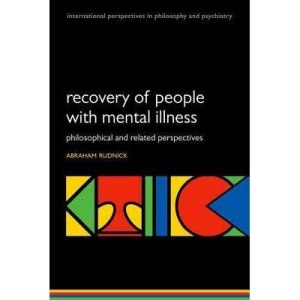
It is only in the past 20 years that the concept of ‘recovery’ from mental health has been more widely considered and researched.
Before then, it was generally considered that ‘stability’ was the best that anyone suffering from a mental disorder could hope for. But now it is recognised that, throughout their mental illness, many patients develop new beliefs, feelings, values, attitudes, and ways of dealing with their disorder. The notion of recovery from mental illness is thus rapidly being accepted and is inserting more hope into mainstream psychiatry and other parts of the mental health care system around the world.
Yet, in spite of conceptual and other challenges that this notion raises, including a variety of interpretations, there is scarcely any systematic philosophical discussion of it. This book is unique in addressing philosophical issues – including conceptual challenges and opportunities – raised by the notion of recovery of people with mental illness. Such recovery – particularly in relation to serious mental illness such as schizophrenia – is often not about cure and can mean different things to different people.
For example, it can mean symptom alleviation, ability to work, or the striving toward mental well-being (with or without symptoms).
The book addresses these different meanings and their philosophical grounds, bringing to the fore perspectives of people with mental illness and their families as well as perspectives of philosophers, mental health care providers and researchers, among others.
The important new work will contribute to further research, reflective practice and policy making in relation to the recovery of people with mental illness.It is essential reading for philosophers of health, psychiatrists, and other mental care providers, as well as policy makers.
Rethinking Psychiatry: From Cultural Category to Personal Experience.
Author(s): Arthur Kleinman, MD.
Year: 2008.
Edition: First (1st).
Publisher: Free Press.
Type(s): Paperback and EPUB.
Synopsis:
In this book, Kleinman proposes an international view of mental illness and mental care.
Arthur Kleinman, M.D., examines how the prevalence and nature of disorders vary in different cultures, how clinicians make their diagnoses, and how they heal, and the educational and practical implications of a true understanding of the interplay between biology and culture.
1927 – R. D. Laing, Scottish psychiatrist and author (d. 1989).
R.D. Laing
Ronald David Laing (07 October 1927 to 23 August 1989), usually cited as R.D. Laing, was a Scottish psychiatrist who wrote extensively on mental illness – in particular, the experience of psychosis.
Laing’s views on the causes and treatment of psychopathological phenomena were influenced by his study of existential philosophy and ran counter to the chemical and electroshock methods that had become psychiatric orthodoxy.
Taking the expressed feelings of the individual patient or client as valid descriptions of lived experience rather than simply as symptoms of mental illness, Laing regarded schizophrenia as a theory not a fact.
Though associated in the public mind with anti-psychiatry he rejected the label. Politically, he was regarded as a thinker of the New Left.
Laing was portrayed by David Tennant in the 2017 film Mad to Be Normal.







 Mental Health Matters
You must be logged in to post a comment.