Book: Cognitive Behaviour Therapy for Eating Disorders

Book Title:

Cognitive Behaviour Therapy for Eating Disorders.

Author(s): Glenn Waller, Helen Cordery, Emma Corstorphine, Hendrik Hinrichsen, Rachel Lawson, Victoria Mountford, and Katie Russell.

Year: 2007.

Edition: First (1st), Illustrated Edition.

Publisher: Cambridge University Press.

Type(s): Paperback and Kindle.

Synopsis:

This book describes the application of cognitive behavioural principles to patients with a wide range of eating disorders – it covers those with straightforward problems and those with more complex conditions or co-morbid states.

The book takes a highly pragmatic view. It is based on the published evidence, but stresses the importance of individualised, principle-based clinical work.

It describes the techniques within the widest clinical context, for use across the age range and from referral to discharge.

Throughout the text, the links between theory and practice are highlighted in order to stress the importance of the flexible application of skills to each new situation. Case studies and sample dialogs are employed to demonstrate the principles in action and the book concludes with a set of useful handouts for patients and other tools.

This book will be essential reading for all those working with eating-disordered patients including psychologists, psychiatrists, nurses, counsellors, dieticians, and occupational therapists.
Book: Cognitive Behaviour Therapy and Eating Disorders

Book Title:

Cognitive Behaviour Therapy and Eating Disorders.

Author(s): Christopher G. Fairburn.

Year: 2008.

Edition: First (1st).

Publisher: Guildford Press.

Type(s): Hardcover and Kindle.

Synopsis:

This book provides the first comprehensive guide to enhanced cognitive behaviour therapy (CBT-E), the leading empirically supported treatment for eating disorders in adults.

Written with the practitioner in mind, the book demonstrates how this transdiagnostic approach can be used with the full range of eating disorders seen in clinical practice.

Christopher Fairburn and colleagues describe in detail how to tailor CBT-E to the needs of individual patients, and how to adapt it for patients who require hospitalisation.

Also addressed are frequently encountered co-occurring disorders and how to manage them.

Reproducible appendices feature the Eating Disorder Examination interview and questionnaire.

Book: The Food Addict’s Meal Prep Manual

Book Title:

The Food Addict’s Meal Prep Manual: Save Yourself From Food Addiction In Only 2 Hours A Week.

Author(s): Dr. Joan Ifland (PhD).

Year: 2018.

Edition: First (1st).

Publisher: ?.

Type(s): Kindle.

Synopsis:

Research shows that addiction to processed foods explains why we overeat. Processed foods are everywhere which makes it very hard to break the food addiction cycle. It seems like people are pushing processed foods at every turn.

But you CAN break the cycle! Having your own beautiful meals is the secret! In The Food Addicts Meal Prep Manual, we’re going to show you step-by-step how to prepare all your meals in only 2 hours a week. Having meals at hand will give you a big advantage in regaining control over your food. This quick, easy guide shows you how to have fun and save lots of money by making all your food in two hours per week.

The guide lets you pick the foods you already love. You will be delighted at how beautiful and delicious these healthy meals are. Learn the surprising truth that ‘healthy’ can be scrumptious, inexpensive, and quick. This guide shows you how.

But you CAN break the cycle! In The Food Addicts Meal Prep Manual, we are going to show you step-by-step how to prepare healthy meals in only 2 hours a week, helping you to break the cycle of sugar, salt and processed foods, which are keeping you from having the body you want.

Go from feeling poor to having endless energy. Finally be able to lose weight and gain back that self-confidence. And most importantly, take back control in your life without the mindless eating and self-shaming that is keeping you locked in the cycle.

Book: Food Junkies: Recovery from Food Addiction

Book Title:

Food Junkies: Recovery from Food Addiction.

Author(s): Vera Tarman.

Year: 2019.

Edition: Second (2nd).

Publisher: Dundurn.

Type(s): Paperback, Audiobook, and Kindle.

Synopsis:

A fact-filled guide to coping with compulsive overeating problems by an experienced addictions doctor who draws on many patients’ stories of recovery.

Overeating, binge eating, obesity, anorexia, and bulimia – Food Junkies tackles the complex, poorly understood issue of food addiction from the perspective of a medical researcher and dozens of survivors. What exactly is food addiction? Is it possible to draw a hard line between indulging cravings for “comfort food” and engaging in substance abuse? For people struggling with food addictions, recognizing their condition remains a frustrating battle.

This revised second edition contains the latest research as well as practical strategies for people facing the complicated challenges of eating disorders and addictions, offering an affirming and manageable path to healthy and sustainable habits.

Book: Food Addiction: Treatment for Overeating

Book Title:

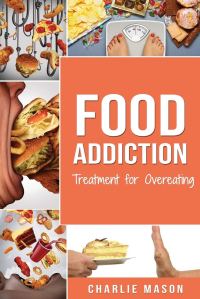
Food Addiction: Treatment for Overeating.

Author(s): Charlie Mason.

Year: 2019.

Edition: First (1st).

Publisher: Tilcan Group Limited.

Type(s): Paperback, Audiobook, and Kindle.

Synopsis:

Millions of people are struggling with their healthy eating and lifestyle to help manage their weight. But what most people do not notice is the link between emotional craving and eating and unwanted weight. A part of your brain tells you that you need to eat a healthy meal but your craving is telling you to reach for the comfort food instead.

Chances are, you end up with the comfort food, but it is not for a lack of willpower or motivation! Food addiction leads to various health-related problems including being over-weight and other eating disorders.

Food addiction is a mental and physical issue that requires mental and physical treatment. Unlike other addictions, you cannot eliminate food from your daily behaviours as you can with smoking or alcohol. You need food to survive. This means you need to find a way to stop your cravings and eat less in a realistic way.

As you navigate through the pages of this book, you will find tips and techniques to help you understand your cravings, how to stop them, and ways to treat your food addiction. Enjoy the simple and easy-to-follow tables, lists, and guides as you choose healthy meals over unhealthy and your wellbeing over cravings.

This book is designed to give you solutions to overeating in an inspiring and unique way!

It aims to reveal to you the common beliefs and thoughts about foods, untangle the addictive impulses programmed in your brain, and how to retrain your mind and body so you can live a healthier, happier, and balanced life with eating.

Using an approachable and factual delivery, Food Addiction: Treatment for Overeating offers you real solutions and simple steps so you can learn how to release the negative feelings entrapping you in your negative habits and the constant drudgery of failed diets and broken assurances.

Book: The Food Addiction Recovery Workbook

Book Title:

The Food Addiction Recovery Workbook: How to Manage Cravings, Reduce Stress, and Stop Hating Your Body.

Author(s): Carolyn Coker Ross (MD, MPH).

Year: 2017.

Edition: First (1st).

Publisher: New Harbinger.

Type(s): Paperback and Kindle.

Synopsis:

If you are struggling with obesity or food addiction, you have probably been told that you must deprive yourself of certain foods in order to lose weight. You may have also been convinced-by the media and by our culture-that if you finally become thin your life will be better, you will be happier, and your suffering will come to an end.

The problem is – it is not all about the food. It is about how food is used to self-soothe, to numb ourselves against the pain of living or to cope with stress and unresolved emotions. Even as your waist whittles away, the problems that caused your food addiction won’t disappear.

The Anchor Programme™ approach detailed in this workbook is not about dieting. It is about being anchored to your true, authentic self. When you find your unique anchor, you will relate better to your body, you will know intuitively how to feed your body, and you will reach the weight that is right for you. Anyone who’s been on the diet treadmill-losing and regaining lost weight-will admit that losing weight does not instantly bring health or happiness. That is because losing weight is a red herring for the real issue, the misuse of food to solve a problem that has nothing to do with food.

This book offers a whole-person approach that blends practical information on managing stress and regulating emotions without relying on food. If you are ready to uncover the true cause of your food addiction, you will finally be able to embrace a balanced diet and reach the weight that is right for you.

Book: The Emotional Eating Workbook

Book Title:

The Emotional Eating Workbook – A Proven-Effective Step-By-Step Guide To End Your Battle With Food And Satisfy Your Soul.

Author(s): Carolyn Coker Ross (MD, MPH).

Year: 2016.

Edition: First (1st).

Publisher: New Harbinger.

Type(s): Paperback and Kindle.

Synopsis:

For over fifty years, nutritional and medical scientists have dissected the problem of obesity. The result of this half-century of investigation has been a series of recommendations about what and how much to eat, and an unintended consequence is that we have been deprived of the joy of eating. From low-fat diets to the no-carb craze, the market has been continually flooded with one assortment of fad products and diets after another. So, when does it end?

If you are struggling with emotional overeating and are trying to lose weight, you should know that you do not need to deny yourself certain foods. In The Emotional Eating Workbook, you will learn about the real psychological needs that underlie your food cravings, how to meet those needs in positive ways, be mindful of your body, and find the deep satisfaction many overeaters seek in food.

It is not about food. It is about how food is used to self-soothe, numb ourselves against the pain of living, or self-medicate in coping with stress and unresolved emotions. The Anchor Programme™ approach detailed in this book is not about dieting. It is about being anchored to your true, authentic self. When you find your unique anchor, you will relate better to your body, you will know intuitively how to feed your body, and you will reach the weight that is right for you.

Book: Eating Disorders – What Everyone Needs to Know

Book Title:

Eating Disorders – What Everyone Needs to Know.

Author(s): B. Timothy Walsh, Evelyn Attia, and Deborah R. Glasofer.

Year: 2020.

Edition: First (1ed).

Publisher: OUP USA.

Type(s): Hardcover, Paperback, and Kindle.

Synopsis:

Eating disorders are potentially life-threatening psychiatric illnesses commonly accompanied by serious medical problems. They typically appear during adolescence or early adulthood, a time when young people are heading to college or interviewing for a first job. Many people recover fully from eating disorders, but others become chronically ill, and symptoms can continue into middle age and beyond.

Written by leading authorities in eating disorders research and treatment, Eating Disorders: What Everyone Needs to Know answers common questions about eating disorders, including anorexia nervosa, bulimia nervosa, and binge eating disorder, as well as a newly described condition, avoidant/restrictive food intake disorder (ARFID). Practical yet authoritative, the book defines the eating disorders, explains what we know about them based on the latest science, and describes how treatment works. Importantly, the book dispels common myths about eating disorders, such as the notion that they occur only amongst the affluent, that they affect only girls and women, or that they simply result from environmental factors such as the fashion industry and society’s obsession with thinness. In reality, as the book explains, there is substantial evidence that eating disorders are brain-based illnesses that do not discriminate, and that they have been around for a very long time. Eating Disorders: What Everyone Needs to Know is essential reading for those seeking authoritative and current information about these often misunderstood illnesses.

Book: The Age of Addiction – How Bad Habits Became Big Business

300300

Book Title:

The Age of Addiction – How Bad Habits Became Big Business.

Author(s): David T. Courtwright.

Year: 2019.

Edition: First (1st).

Publisher: Harvard University Press..

Type(s): Hardcover, Paperback, Audiobook, and Kindle.

Synopsis:

We live in an age of addiction, from compulsive gaming and shopping to binge eating and opioid abuse.

Sugar can be as habit-forming as cocaine, researchers tell us, and social media apps are deliberately hooking our kids.

But what can we do to resist temptations that insidiously rewire our brains? A renowned expert on addiction, David Courtwright reveals how global enterprises have both created and catered to our addictions.

The Age of Addiction chronicles the triumph of what he calls “limbic capitalism,” the growing network of competitive businesses targeting the brain pathways responsible for feeling, motivation, and long-term memory.

Eating Disorders: Linking Self, Other, & Gaze

Research Paper Title

The Pathogenic and Therapeutic Potential of the Gaze of the Other in the Clinic of “Eating Disorders”.

Background

Building on the optical-coenaesthetic disproportion model of so-called eating disorders, this paper provides a framework for the psychotherapy of people affected by these conditions.

This model characterises “eating disorders” as disorders of embodiment and identity, where a sense of unfamiliarity with one’s own flesh, experienced as shifting and incomprehensible, leads to an impairment in the constitution of the Self and thus of one’s own identity.

Since there is a deficit of the coenaesthetic experience of the embodied Self, greater importance is assumed by body perception conveyed from without. To these persons, their corporeality is principally given as a body-object “to be seen” from a third-person perspective, rather than as a body-subject “to be felt” from a first-person perspective.

The Other’s look serves as an optical prosthesis to cope with dis-coenaesthesia and as a device through which these persons can define themselves. They are unable to accept the hiatus between “being a body” and “having a body,” constitutively present in every human being, forcibly trying to recouple it, and finally ending up objectifying themselves to succeed.

The external foundation of the Self thus takes the form of a constriction one can never be completely free of. Psychotherapy should thus accompany persons affected by eating disorders in their encounter with the miscarried dialectic between feeling oneself from within and seeing oneself from without through the gaze of the Other, so keenly feared by people desperately in search of self-control.

Tactfully, the clinician accompanies the patient in taking a stance towards their symptom as the outcome of this miscarried dialectics, which is one premise for overcoming it.

The clinician’s gaze becomes the herald of recognition, allowing the patient to feel accepted in terms of their individuality. Feeling themselves touched by a gaze that waives its alienating potential in order to signify acceptance reactivates the identity-forming dialectics. Their body is thus revealed as the receiver of gazes, but also rediscovers its own possibility for self-determination starting out from these gazes.

This intersubjective resonance between the clinician’s gaze and the patient reactivates the identity-making dialectics between body-subject and body-object, creating the relational premises for overcoming the symptom.

Reference

Esposito, C.M. & Stanghellini, G. (2020) The Pathogenic and Therapeutic Potential of the Gaze of the Other in the Clinic of “Eating Disorders”. Psychopathology. 1-7. doi: 10.1159/000509625. Online ahead of print.